TL;DR: Claude is currently the best AI model for “thinking-heavy” SEO tasks — keyword clustering, content outlining, entity extraction, and existing-page diagnostics. But don’t treat it like autopilot. You need to feed it real data and structured constraints. This post covers 7 battle-tested workflows, each with a copy-paste-ready prompt template. Ready to jump in? Click here to get the Claude API Key →
📖 Who this is for
This post assumes you already have SEO fundamentals down and want to integrate Claude into your existing workflow via API calls, prompt engineering, and data-driven analysis.
If you’re just getting started with SEO and haven’t used AI tools before, check out the beginner-friendly guide first: Zero-code guide: Using Cherry Studio to access the Claude API and run through the SEO workflow →
1. The Real State of Claude in SEO in 2026
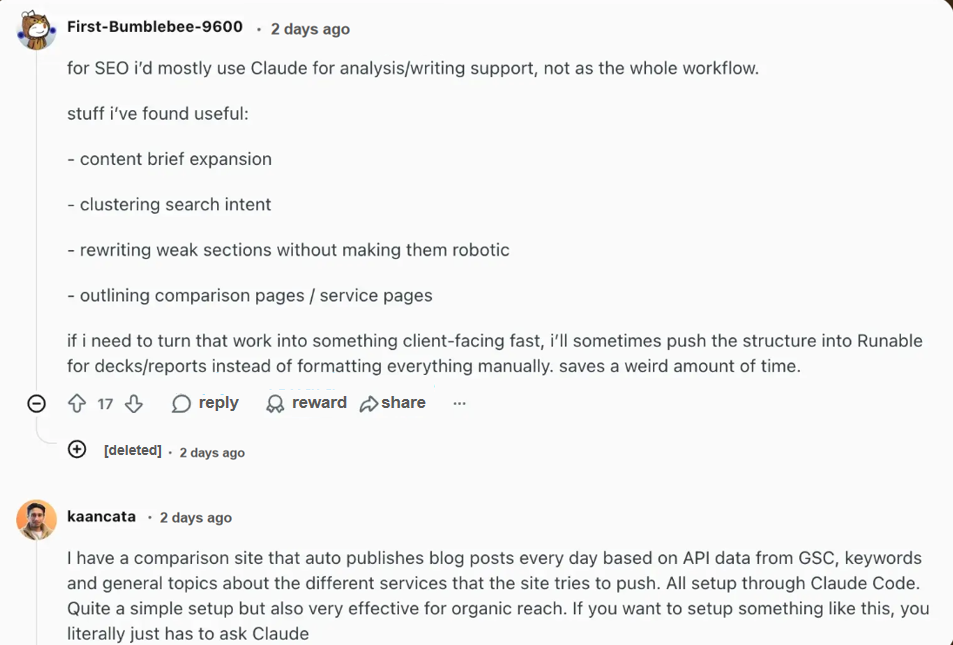
Spend a few minutes on SEO Twitter/X or r/SEO and you’ll notice the conversation has shifted. Nobody’s asking “can Claude write my blog posts?” anymore. The discussions have moved deeper — content refresh prompts, internal link map generation, intent clustering workflows, QA checklists.
That shift says something important: Claude’s role in SEO is maturing. It’s no longer a novelty. Practitioners are treating it as a serious workflow component.
At the same time, the search landscape itself is undergoing a paradigm shift. Conductor’s analysis of 21.9 million queries shows Google AI Overviews now appearing in over 25% of searches. A next study of 17.2 million AI citations from Q4 2025 uncovered a striking pattern: different AI platforms show significantly different source preferences — Claude tends to favor UGC (user-generated content), while ChatGPT leans toward Wikipedia. The takeaway is clear: you genuinely cannot use one content strategy to win across all platforms. Optimizing for each AI’s citation preferences is no longer optional.
Claude Sonnet 4.6: What Changed for SEO Workflows
On February 17, 2026, Anthropic released Claude Sonnet 4.6, - — an update with real, practical implications for SEO work. Here’s what matters:
- Adaptive Thinking: Claude automatically decides when to engage deep reasoning vs. when to move fast. It’ll switch into extended thinking mode for competitive analysis, then shift to high-speed output for bulk meta description generation. No wasted compute.
- 1 Million Token Context Window: In a single request, you can now feed it GSC export data, 10 competitor articles, your site’s full URL list, and your brand voice guidelines — all at once.
- Context Compaction: Claude auto-summarizes early parts of long conversations so it doesn’t “forget” context mid-workflow. Critical for complex, multi-step analysis tasks.
- Web Search Dynamic Filtering: Before search results enter the context, Claude runs code to filter out irrelevant hits. Noticeably better accuracy, lower token spend.
On the GDPval-AA real-world work benchmark, Sonnet 4.6 reached 1633 Elo, ranking first globally and outperforming Anthropic’s own flagship Opus 4.6 (1606) by 27 points. This is the first time a Sonnet model has surpassed Opus on a major benchmark. Pricing also remained the same as the previous generation: $3 / $15 per million tokens for input and output.
But before you drop Claude into your workflow, there is one mindset shift worth making:
Claude is essentially an SEO analyst trapped inside a chat interface. It still needs real data, structured constraints, and human verification.
Treat it as a “keyword in → perfect SEO article out” vending machine, and you’ll end up publishing a pile of undifferentiated content — then spending time on damage control.
The right mental model: position Claude as your Advanced Content Strategy Analyst - It handles structure, logic, and directional judgment. You supply the business context and validate the answers.
2. What Claude Is (and Isn’t) Good at for SEO
Before wiring Claude API into your SEO stack, use this table to calibrate your expectations:
| Task Type | Claude’s Strength | Notes |
|---|---|---|
| Keyword intent classification | ✅ Strong | Stable output given structured input |
| SERP-aligned content outlining | ✅ Strong | Requires competitor title structure as input |
| Entity Extraction & Topic Mapping | ✅ Strong | Long-text analysis is a clear advantage |
| Content refresh planning for existing pages | ✅ Strong | Needs GSC data as context |
| Internal Link Planning | ✅ Moderate | Requires your site URL list |
| Editorial QA / Fact Checking | ✅ Moderate | Human review still required for data claims |
| Real-time SERP data pulling | ❌ Weak | Can’t crawl SERPs — you must supply the data |
| Backlink Analysis | ❌ Weak | No crawling capability — use dedicated tools |
| Keyword volume / difficulty | ❌ Weak | Data may be stale — must use professional tools |
| Business Strategy Decisions | ❌ Weak | Doesn’t know your margins or conversion funnel |
| First-hand experience content | ❌ Weak | No lived experience — prone to hallucination |
The rule of thumb is simple: If the task is “reasoning + synthesis + structured output,” Claude can handle it. If it’s “real-time data + crawling + quantitative metrics,” stick with purpose-built SEO tools.
3. 7 High-Value SEO Workflows + Complete Prompts
3.1 Keyword Intent Clustering & Topic Clustering
Why You Can’t Skip This Step
Most teams skip intent clustering because they assume “we already know the intent.” Then you discover pages stuck on page 2 because they’re targeting two conflicting intents simultaneously — or the opposite problem: five pages cannibalizing each other over a single intent. These issues are notoriously hard to spot, and the cost of missing them is high.
Claude can take a keyword list of 200–1,000 terms and rapidly sort them into intent-based groups — but only if you feed it real data. Don’t ask it to guess.
Workflow: Export your keyword list from GSC, Ahrefs, or Semrush. Keep the columns that matter: keyword, monthly search volume (or impressions), and current ranking page. Then paste it directly into Claude.
📋 Copy-Ready Prompt Template:
You are a senior SEO content strategist. Please perform intent clustering on the following keyword list.

Rules:
- Generate a maximum of 10 clusters
- Each cluster must have a clear "primary intent" label
  (Informational, Commercial Investigation, Transactional,
  Navigational, Troubleshooting, Comparison)
- Identify the most likely SERP content format for each cluster (Listicle, Landing Page, Template, Definition Page, Tool Page,  Comparison Page, How-to)
- If multiple clusters could map to the same URL type,
  flag them as "Potential Cannibalization Risk"

Output format: Markdown table
Columns: Cluster Name | Primary Intent | SERP Format | Core Keywords | Long Tail Supporting Terms | Notes

Keyword List:
{paste your keyword list}
You are a senior SEO content strategist. Please perform intent clustering on the following keyword list.

Rules:
- Generate a maximum of 10 clusters
- Each cluster must have a clear "primary intent" label
  (Informational, Commercial Investigation, Transactional,
  Navigational, Troubleshooting, Comparison)
- Identify the most likely SERP content format for each cluster (Listicle, Landing Page, Template, Definition Page, Tool Page,  Comparison Page, How-to)
- If multiple clusters could map to the same URL type,
  flag them as "Potential Cannibalization Risk"

Output format: Markdown table
Columns: Cluster Name | Primary Intent | SERP Format | Core Keywords | Long Tail Supporting Terms | Notes

Keyword List:
{paste your keyword list}
Once you have the output, check three things: Are the clusters mutually exclusive? Spot-check 3–5 head terms manually to verify the SERP format recommendations. And watch for “micro-clusters” that are essentially just synonyms — if you find them, merge them.
3.2 SERP-Aligned Content Outline Generation
The core logic: A good outline = 1 round of edits. A bad outline = 3 rounds of rewrites. The math is obvious. The secret to getting Claude to produce a high-quality outline isn’t asking it to guess what SERP looks like — it’s feeding it the actual H2/H3 structure of your top-ranking competitors. That one input difference determines whether the output is useful or trash.
Workflow: Google your target keyword → open the top 5 results → copy the H2/H3 heading structure from each → combine with your target audience profile, page goal, and writing constraints → hand it all to Claude.
📋 Reusable Prompt template:
You are an SEO content strategist. Generate a SERP-aligned content outline
for the following target keyword.

Target keyword: {keyword}
Target Readers: {reader profile, e.g. indie store owners with 1–3 years of experience, familiar with basic SEO}
Page goal: {the action or decision the reader should make after reading}
Constraints: No filler. Real examples and data only.
             Do not fabricate statistics.

Competitor heading structure:
Competitor 1:
- H2: ...
- H3: ...
Competitor 2:
- H2: ...

Please generate:
1. 3 recommended H1 options
2. full H2/H3 outline
3. For each H2: a) what reader problem it addresses,
   b) how we differentiate from competitors
4. Which sections should include a CTA
You are an SEO content strategist. Generate a SERP-aligned content outline
for the following target keyword.

Target keyword: {keyword}
Target Readers: {reader profile, e.g. indie store owners with 1–3 years of experience, familiar with basic SEO}
Page goal: {the action or decision the reader should make after reading}
Constraints: No filler. Real examples and data only.
             Do not fabricate statistics.

Competitor heading structure:
Competitor 1:
- H2: ...
- H3: ...
Competitor 2:
- H2: ...

Please generate:
1. 3 recommended H1 options
2. full H2/H3 outline
3. For each H2: a) what reader problem it addresses,
   b) how we differentiate from competitors
4. Which sections should include a CTA
3.3 Entity Extraction & Topic Coverage Audit
This is one of the most overlooked but highest-ROI workflows — do it once and you’ll never want to go back.
Paste a draft (or a competitor’s article) into Claude. Ask it to extract named entities (brands, tools, standards, people), core concepts, subtopics Google expects this content to cover, and flag any missing definitions or keyword-stuffing signals.
📋 Reusable Prompt template:
Please perform entity extraction and topic coverage analysis on the following content.

Target word: {keyword}

Task:
1. Extract entities, grouped by type: products/tools, concepts, metrics,
   processes, roles, regions, standards
2. List 15–20 subtopics Google expects this content to cover for "{keyword}"
   (based on your training data, not real-time SERP)
3. Identify topics that are missing or insufficiently explained in the draft
4. Flag words that appear too frequently and may constitute keyword-stuffing signals
Full draft:
{paste content}
Please perform entity extraction and topic coverage analysis on the following content.

Target word: {keyword}

Task:
1. Extract entities, grouped by type: products/tools, concepts, metrics,
   processes, roles, regions, standards
2. List 15–20 subtopics Google expects this content to cover for "{keyword}"
   (based on your training data, not real-time SERP)
3. Identify topics that are missing or insufficiently explained in the draft
4. Flag words that appear too frequently and may constitute keyword-stuffing signals
Full draft:
{paste content}
Turn the output into an editorial review checklist. Run every article through it before publishing — and content quality has a standardized floor.
3.4 Declining Page Diagnosis & Refresh Plan (Highest-ROI Workflow)
For sites with an existing content library, refreshing old pages almost always drives ranking recovery faster than publishing new ones. High ROI, widely ignored.
Claude’s core value here is turning your GSC data and page diagnostics into a prioritized refresh action list. Without feeding it real data first, you’ll get generic advice like “add more examples” or “improve readability” — technically correct, completely useless.
Workflow: In GSC, find pages where clicks have dropped more than 15% over the past 3 months → export the associated queries, average position, CTR, and the date traffic started declining → then paste in the page’s current outline and key paragraphs.
📋 Reusable Prompt template:
You are an SEO content strategist. Create a content refresh plan for the following URL.
Goal: improve click-through rate and ranking stability for these queries through a targeted refresh.
Page data:
- Primary target keyword: {keyword}
- Keywords losing rankings: {keyword1, keyword2, keyword3}
- Current average position: {x}
- CTR: {x%}
- Traffic decline start date: {date}
- Context: {e.g. competitor launched new feature, Google algorithm update, product is now outdated}
Current page outline:
{paste H2/H3 structure}
Please output:
1. 10 refresh actions, each tagged with impact level (high/medium/low)
   and execution difficulty (high/medium/low)
2. For each action: what to change → why it helps the target intent →
   how to verify results in GSC
3. Suggested internal link anchor text to add (based on page intent only, do not fabricate URLs)
4. Recommended updated Meta Title and H1 (3 options each)
You are an SEO content strategist. Create a content refresh plan for the following URL.
Goal: improve click-through rate and ranking stability for these queries through a targeted refresh.
Page data:
- Primary target keyword: {keyword}
- Keywords losing rankings: {keyword1, keyword2, keyword3}
- Current average position: {x}
- CTR: {x%}
- Traffic decline start date: {date}
- Context: {e.g. competitor launched new feature, Google algorithm update, product is now outdated}
Current page outline:
{paste H2/H3 structure}
Please output:
1. 10 refresh actions, each tagged with impact level (high/medium/low)
   and execution difficulty (high/medium/low)
2. For each action: what to change → why it helps the target intent →
   how to verify results in GSC
3. Suggested internal link anchor text to add (based on page intent only, do not fabricate URLs)
4. Recommended updated Meta Title and H1 (3 options each)
3.5 Internal Link Planning (Not Just “Add More Links”)
Claude is surprisingly good at internal linking — but only if you give it your site structure first. It has no idea what pages you have. You have to tell it.
📋 Reusable Prompt templates:
Please create an internal linking plan for the following target page.
Target page: {URL or page title}
Site page inventory (URL | page type | core topic):
{paste list, e.g.
/blog/claude-api-guide  |  tutorial post  |  Claude API integration guide
/pricing                |  pricing page   |  Claude API pricing
...}
Please provide:
1. 10 recommended inbound links (other pages → target page), with suggested anchor text variations and recommended placement within each source page
2. 10 recommended outbound links (target page → other pages), with anchor text and linking rationale
3. Anchor text diversity: exact-match anchor text used no more than 2 times
4. Anchor text should read naturally — avoid forced or over-optimized phrasing
Please create an internal linking plan for the following target page.
Target page: {URL or page title}
Site page inventory (URL | page type | core topic):
{paste list, e.g.
/blog/claude-api-guide  |  tutorial post  |  Claude API integration guide
/pricing                |  pricing page   |  Claude API pricing
...}
Please provide:
1. 10 recommended inbound links (other pages → target page), with suggested anchor text variations and recommended placement within each source page
2. 10 recommended outbound links (target page → other pages), with anchor text and linking rationale
3. Anchor text diversity: exact-match anchor text used no more than 2 times
4. Anchor text should read naturally — avoid forced or over-optimized phrasing
3.6 Content Editorial QA & Fact Check
Claude works well as an editorial assistant — run a QA pass before every publish and catch the issues that slip through.
📋 Copy-Ready QA Prompt Template:
Please perform a QA review of the following draft as an SEO content editor.

Review rubric:
1. Intent satisfaction score (0–5), with explanation
2. Missing sections or unanswered reader questions
3. Claims that require source citations (flag line by line)
4. Contradictions or vague statements
5. Internal linking opportunities (suggest anchor text only, do not fabricate URLs)
6. H1/H2 structure and ordering recommendations
7. Whether CTAs are aligned with the page's stated goal

Full Draft:
{paste content}
Please perform a QA review of the following draft as an SEO content editor.

Review rubric:
1. Intent satisfaction score (0–5), with explanation
2. Missing sections or unanswered reader questions
3. Claims that require source citations (flag line by line)
4. Contradictions or vague statements
5. Internal linking opportunities (suggest anchor text only, do not fabricate URLs)
6. H1/H2 structure and ordering recommendations
7. Whether CTAs are aligned with the page's stated goal

Full Draft:
{paste content}
3.7 Multilingual SEO Localization (With a Key Warning)
Claude’s value in multilingual SEO isn’t just translation — it’s localization: making content match how people actually search in a target market, not just making it grammatically correct.
A common trap worth flagging:
If you ask Claude to simply translate your English keyword strategy, you’ll often end up with content that’s grammatically perfect but pulls zero search traffic. The keywords don’t map to how local users actually query.
The right approach:
- Feed Claude native keywords from the target market — not direct translations of your English terms
- Provide the product vocabulary actually used in that market (terminology varies significantly across regions)
- Include 2–3 competitor articles from the same market as tone and style reference
4. Two End-to-End Workflows You Can Copy
Workflow A: Keyword List → Publishable Content Briefs
This workflow is a strong fit for small teams of 2–3 people or for situations where you have a growing backlog of topics to work through.
| Step | Inputs | Claude Output | Tool |
|---|---|---|---|
| Step 1: Intent Clustering | 200~1000 Keywords CSV | 6~10 Clusters + Recommended Page Types | Claude API |
| Step 2: Brief Generation | Clustering + Competitor H2/H3 + Reader Profile | Full Content Brief (Intent Statement, Outline, Examples, Inline Placeholders) | Claude API |
| Step 3: Content Production | Content Briefing | First Draft | Claude API / Editing |
| Step 4: QA | First Draft | QA report + revision suggestions | Claude API |
| Step 5: Fact Checking | Flagged Statements in QA Report | ✅/❌ Manual Verification | Human |
| Step 6: Publish | Final Draft | - | CMS |
Workflow B: GSC Data → Inventory Page Refresh
| Steps | Actions |
|---|---|
| Signal Collection | Pull GSC data: lost query impressions + ranking/CTR changes + competitor updates (manual review) |
| Refresh Plan | Use the prompt from Section 3.4 — map lost queries to current page state |
| Manual Verification | Manually confirm SERP formatting changes; verify source of all “best practice” statements |
| Execute | Update Title/Meta → change corresponding query term paragraphs → add internal links |
| Tracking | GSC records date of update, look for changes after 14-28 days |
5. What’s Next: GEO / AEO Optimization + Claude as a Coworker
5.1 GEO and AEO: Why Traditional SEO Is No Longer Enough
Conductor data shows AI Overviews now appear in over 25% of Google searches. Gartner predicts that by 2028, 50% of searches will involve an AI assistant. Two optimization directions have become impossible to ignore:
GEO (Generative Engine Optimization) is about making your content easier for AI systems — ChatGPT, Perplexity, Google AI Overviews, Claude — to retrieve and cite. AEO (Answer Engine Optimization) focuses specifically on direct-answer scenarios, structuring content so AI can extract it as the “ideal citation.”
A few interesting data points (source: platform research, 2025–2026):
- An Ahrefs analysis of 17 million citations found AI systems prefer citing more recently published content — on average 25.7% fresher than traditional organic results
- The first 30% of an article (the intro section) accounts for 44.2% of all AI citations, while the conclusion contributes only 24.7% (Growth Memo, February 2026)
- Citation volume for the same brand can vary by as much as 615x between Grok and Claude (Superlines, March 2026) The practical takeaway is straightforward: position equals citation rate. Core facts, data, and direct conclusions belong at the very top — not buried in the body where readers have to scroll to find them.
📋GEO Content Audit Prompt:
You are a GEO optimization specialist. Analyze the following content and identify what's preventing it from being cited by AI platforms.

Target query: {the question this content is meant to answer}

Full content: {paste}

Analysis dimensions:
1. Is there a paragraph that directly answers the target query (≤3 sentences, fact-dense)? Where is it located?
2. Does the content before the first H2 include a core conclusion?
3. Are named entities (brands, people, tools, standards) clearly labeled?
4. Does it contain standalone statements that can be "clipped" — sentences that make sense without surrounding context?
5. Are there FAQ Schema opportunities worth adding?
6. Which paragraphs are most likely to be cited by AI? Which are least likely?
Output: a list of issues + specific rewrite suggestions for each
You are a GEO optimization specialist. Analyze the following content and identify what's preventing it from being cited by AI platforms.

Target query: {the question this content is meant to answer}

Full content: {paste}

Analysis dimensions:
1. Is there a paragraph that directly answers the target query (≤3 sentences, fact-dense)? Where is it located?
2. Does the content before the first H2 include a core conclusion?
3. Are named entities (brands, people, tools, standards) clearly labeled?
4. Does it contain standalone statements that can be "clipped" — sentences that make sense without surrounding context?
5. Are there FAQ Schema opportunities worth adding?
6. Which paragraphs are most likely to be cited by AI? Which are least likely?
Output: a list of issues + specific rewrite suggestions for each
5.2 Claude Cowork: Automating Your SEO Workflow
On January 12, 2026, Anthropic launched Claude Cowork — an autonomous agent running inside the Claude desktop app. It rolled out to Max subscribers first, expanded to Pro users on January 16, reached Team and Enterprise plans on January 23, and the Windows version went live on February 10, 2026, with full feature parity with macOS.
Unlike a standard chat session, Cowork can directly access local folders you designate, build its own execution plan, and carry out multi-step tasks autonomously — continuing to work while you’re away, no hand-holding required.
Practical value for SEO teams:
| Tasks | What Cowork can do |
|---|---|
| GSC Data Processing | Read Read CSV → auto-classify declining pages → generate prioritized refresh report |
| Bulk content QA | Scan drafts folder → run QA checklist on each article → output summary report |
| Competitor content research | Extract key info from multiple source files → merge into structured comparison table |
| Recurring tasks |
A few things worth knowing before you dive in: Cowork burns significantly more tokens than a standard chat session, so complex tasks will hit your usage limit faster. Pro plan users hit that ceiling earlier than Max users. Folder permissions must be explicitly configured — Claude can only access directories you’ve authorized. Also, this feature is still in Research Preview and actively being iterated on.
6. Claude API Access: Code Samples
The following is the code example of calling Claude through claudeapi.com. claudeapi.com is compatible with Anthropic official format, and can be directly connected in China.
Python example (keyword clustering task)
import anthropic

client = anthropic.Anthropic(
    api_key="your-claudeapi-key",
    base_url="https://claudeapi.com" # claudeapi.com proxy node
)

keywords = """
claude api, claude api price, claude api key, how to use claude api,
claude vs gpt4, claude for seo, claude content writing, anthropic claude api
"""

prompt = f"""
You are an SEO strategist. Please perform intent clustering for the following keywords.

Rules:
- Up to 8 clusters
- Each cluster is labeled: primary intent, recommended SERP format, potential cannibalization risk.
- Output Markdown table

Keywords list:
{keywords}
"""

message = client.messages.create(
    model="claude-sonnet-4-6",
    message = client.messages.create( model="claude-sonnet-4-6", max_tokens=2000,
    messages=[{"role": "user", "content": prompt}]
)

print(message.content[0].text)
import anthropic

client = anthropic.Anthropic(
    api_key="your-claudeapi-key",
    base_url="https://claudeapi.com" # claudeapi.com proxy node
)

keywords = """
claude api, claude api price, claude api key, how to use claude api,
claude vs gpt4, claude for seo, claude content writing, anthropic claude api
"""

prompt = f"""
You are an SEO strategist. Please perform intent clustering for the following keywords.

Rules:
- Up to 8 clusters
- Each cluster is labeled: primary intent, recommended SERP format, potential cannibalization risk.
- Output Markdown table

Keywords list:
{keywords}
"""

message = client.messages.create(
    model="claude-sonnet-4-6",
    message = client.messages.create( model="claude-sonnet-4-6", max_tokens=2000,
    messages=[{"role": "user", "content": prompt}]
)

print(message.content[0].text)
Python example (batch QA review)
import anthropic

client = anthropic.Anthropic(
    api_key="your-claudeapi-key",
    base_url="https://code0.ai"
)

def seo_qa_audit(draft_content: str, target_keyword: str) -> str.
    """Perform SEO QA audit on draft articles""""

    prompt = f"""
    Please review the following draft as an SEO content editor.

    Target word: {target_keyword}

    Review Dimensions:
    1. Intent Satisfaction (0 to 5 points)
    2. missing topics (list)
    3. Sentences needing source citation (mark each one)
    4. H2 order optimization suggestions
    5. CTA alignment

    Draft:
    {draft_content}
    """

    response = client.messages.create(
        model="claude-sonnet-4-6",
        model="claude-sonnet-4-6", max_tokens=1500,
        messages=[{"role": "user", "content": prompt}]
    )

    return response.content[0].text

# Example usage
audit_result = seo_qa_audit(
    draft_content="(Paste your draft)",
    target_keyword="Claude API SEO"
)
print(audit_result)
import anthropic

client = anthropic.Anthropic(
    api_key="your-claudeapi-key",
    base_url="https://code0.ai"
)

def seo_qa_audit(draft_content: str, target_keyword: str) -> str.
    """Perform SEO QA audit on draft articles""""

    prompt = f"""
    Please review the following draft as an SEO content editor.

    Target word: {target_keyword}

    Review Dimensions:
    1. Intent Satisfaction (0 to 5 points)
    2. missing topics (list)
    3. Sentences needing source citation (mark each one)
    4. H2 order optimization suggestions
    5. CTA alignment

    Draft:
    {draft_content}
    """

    response = client.messages.create(
        model="claude-sonnet-4-6",
        model="claude-sonnet-4-6", max_tokens=1500,
        messages=[{"role": "user", "content": prompt}]
    )

    return response.content[0].text

# Example usage
audit_result = seo_qa_audit(
    draft_content="(Paste your draft)",
    target_keyword="Claude API SEO"
)
print(audit_result)
Node.js example (internal link planning)
import Anthropic from "@anthropic-ai/sdk";

const client = new Anthropic({
  apiKey: "your-claudeapi-key",
  baseURL: "https://claudeapi.com",
});

const siteInventory = `
/blog/claude-api-guide | Tutorials | Claude API Access Tutorials
/pricing | pricing pages | Claude API pricing schemes
/blog/claude-vs-gpt4 | Comparison Articles | Claude vs GPT-4 Comparison
/docs/quickstart | documentation | quickstart guide
`;

async function generateInternalLinkPlan(targetPage) {
  const message = await client.messages.create({
    model: "claude-sonnet-4-6",
    max_tokens: 1500,
    messages: [
      {
        role: "user",
        content: `
Create an internal link plan for the following target pages.

Target page: ${targetPage}

Site Inventory:
${siteInventory}

Please provide:
1. 8 recommended inbound links (source page → target page + anchor text + insertion position)
2. 8 recommended outgoing links (target page → other pages + anchor text + reason)
3. Make sure the anchor text is naturally diverse
      `, }
      }, }, ], }, }, }, }, }, }, }, }, }
    ], }
  }).

  return message.content[0].text;
}

generateInternalLinkPlan("/blog/claude-for-seo").then(console.log);
import Anthropic from "@anthropic-ai/sdk";

const client = new Anthropic({
  apiKey: "your-claudeapi-key",
  baseURL: "https://claudeapi.com",
});

const siteInventory = `
/blog/claude-api-guide | Tutorials | Claude API Access Tutorials
/pricing | pricing pages | Claude API pricing schemes
/blog/claude-vs-gpt4 | Comparison Articles | Claude vs GPT-4 Comparison
/docs/quickstart | documentation | quickstart guide
`;

async function generateInternalLinkPlan(targetPage) {
  const message = await client.messages.create({
    model: "claude-sonnet-4-6",
    max_tokens: 1500,
    messages: [
      {
        role: "user",
        content: `
Create an internal link plan for the following target pages.

Target page: ${targetPage}

Site Inventory:
${siteInventory}

Please provide:
1. 8 recommended inbound links (source page → target page + anchor text + insertion position)
2. 8 recommended outgoing links (target page → other pages + anchor text + reason)
3. Make sure the anchor text is naturally diverse
      `, }
      }, }, ], }, }, }, }, }, }, }, }, }
    ], }
  }).

  return message.content[0].text;
}

generateInternalLinkPlan("/blog/claude-for-seo").then(console.log);
💡 Get API Key: Visit claudeapi.com .
7. Claude’s Limitations and Risks (2025 Testing)
⚠️ Claude is not a SERP crawler
Claude’s hallucination risk is highest in these output types: statistics (“studies show X%…”), tool pricing, claims like “Google officially states…”, legal or compliance statements, and specific product feature descriptions.
The rule of thumb: the more confident it sounds, the more carefully you should verify.
Defensive prompt (append to any fact-heavy task):
Flag all sentences that contain specific factual claims or require a cited source.
Append [needs verification] to the end of each flagged sentence.
Do not provide URLs unless I supply the source in the prompt.
Flag all sentences that contain specific factual claims or require a cited source.
Append [needs verification] to the end of each flagged sentence.
Do not provide URLs unless I supply the source in the prompt.
⚠️ Claude Is Not a SERP Crawler
Claude cannot “check the current SERP” unless you paste the data in yourself. For real-time SERP insights, pull your data first from tools like Ahrefs, Semrush, or Screaming Frog — then hand it off to Claude for analysis.
⚠️ Strategic Decisions Still Need a Human
Claude doesn’t know your margin, your sales cycle, your churn drivers, or your stakeholders’ risk tolerance. Left unchecked, it might recommend an enterprise content strategy for a self-serve product. Business judgment can’t be outsourced to it.
⚠️ Brand Voice Drift
Generate 50 articles across separate chat sessions and your tone consistency will eventually fall apart. The fix is straightforward: prepend 2–3 paragraphs of brand voice examples at the start of every prompt, and use a fixed system prompt template instead of rewriting it each time.
8. Claude vs. Dedicated SEO Tools: Who Does What
| Tasks | Use Claude | Use SEO Tools |
|---|---|---|
| Keyword Clustering Logic | ✅ | - |
| Competitor outline analysis | ✅ (paste in the data) | - |
| Entity Extraction | ✅ | - |
| Internal linking strategy (based on your sitemap) | ✅ | - |
| Editorial QA | ✅ | - |
| Live rankings / traffic data | - | ✅ GSC / Ahrefs |
| Keyword Difficulty / Search Volume | - | ✅ Semrush / Ahrefs |
| Site crawling / technical SEO | - | ✅ Screaming Frog |
| Backlink analysis | - ✅ Majestic / Ahrefs | |
| CMS Publishing Automation | - | ✅ Dedicated content platforms |
The right stack for a small team is actually straightforward: pull keywords, rankings, and traffic from GSC + Ahrefs/Semrush; use the Claude API for clustering, outlining, refresh planning, and QA; pair an editor with Claude for drafting; publish directly in your CMS. Four distinct layers, each owning its job — no overlap, no confusion.
9. Frequently Asked Questions FAQ
Q1: For SEO work, should I use Claude Sonnet 4.6 or Opus 4.6?
Sonnet 4.6 is the right call for the vast majority of SEO tasks. On the GDPval-AA real-world office task benchmark, Sonnet 4.6 scores 1633 Elo — beating Opus 4.6 (1606) — marking the first time a Sonnet model has surpassed Opus on a major benchmark. And it costs just one-fifth the price: $3/$15 vs. $15/$75 per million tokens. Only reach for Opus 4.6 when a task genuinely demands deep multi-step reasoning — think ARC-AGI-2-style problems or extremely long inference chains.
Q2: Does Claude’s knowledge cutoff affect SEO work?
Barely — for structural tasks like keyword clustering, outline generation, and internal linking strategy, the cutoff is largely irrelevant. Where it matters is time-sensitive questions like “what changed in Google’s latest algorithm update.” For those, pair Claude with a live web search tool instead of relying on it alone.
Q3: What’s the difference between the Claude API and using Claude.ai directly?
The API lets you batch-process requests, wire Claude into automated workflows (Python/Node.js scripts), and enforce consistent tone through a System Prompt. For any team handling 50+ pieces of content, the API isn’t optional — running everything manually through a browser interface just doesn’t scale.
Q4: Is the Claude API on claude.ai the same model as Anthropic’s official API?
Yes. claude.ai is an access proxy for Anthropic’s Claude — it routes directly to the official Claude models. No fine-tuned variants, no modified versions.
Q5: Will Google penalize content written with Claude’s help?
Google’s stated position is that it evaluates content quality and user value — not whether AI was involved in producing it. Claude-assisted content that’s been human-reviewed, brings a distinct perspective, and genuinely satisfies search intent performs the same as hand-written content in rankings. The real risk is undifferentiated mass generation — not AI use itself.
Q6: How many tokens does a typical SEO task consume?
Here are some rough benchmarks:
- Keyword clustering (200 keywords): ~3,000 tokens input + 1,000 output.
- Outline generation: ~1,500 tokens input + 800 output.
- Full article QA (2,000-word draft): ~4,000 tokens input + 1,500 output.
At claude-sonnet-4-6 pricing, most individual tasks cost well under $0.1.
Closing Thoughts: Use Claude Right — Don’t Overuse It
Claude is not your SEO strategy. It’s not your final draft. And it’s definitely not your fact-checker.
What it is good at: helping you think more clearly, spot patterns faster, and make better decisions — especially for intent clustering, outline generation, entity extraction, content refresh planning, internal linking, and editorial QA.
Start using the Claude API for SEO now →
Visit claudeapi.com to get API Key:
- ✅ Direct access from anywhere — no VPN required
- ✅ Pay-as-you-go pricing, no subscription lock-in
- ✅ Latest models supported: claude-sonnet-4-6 / claude-opus-4-6
- ✅ Fully compatible with the official Anthropic SDK