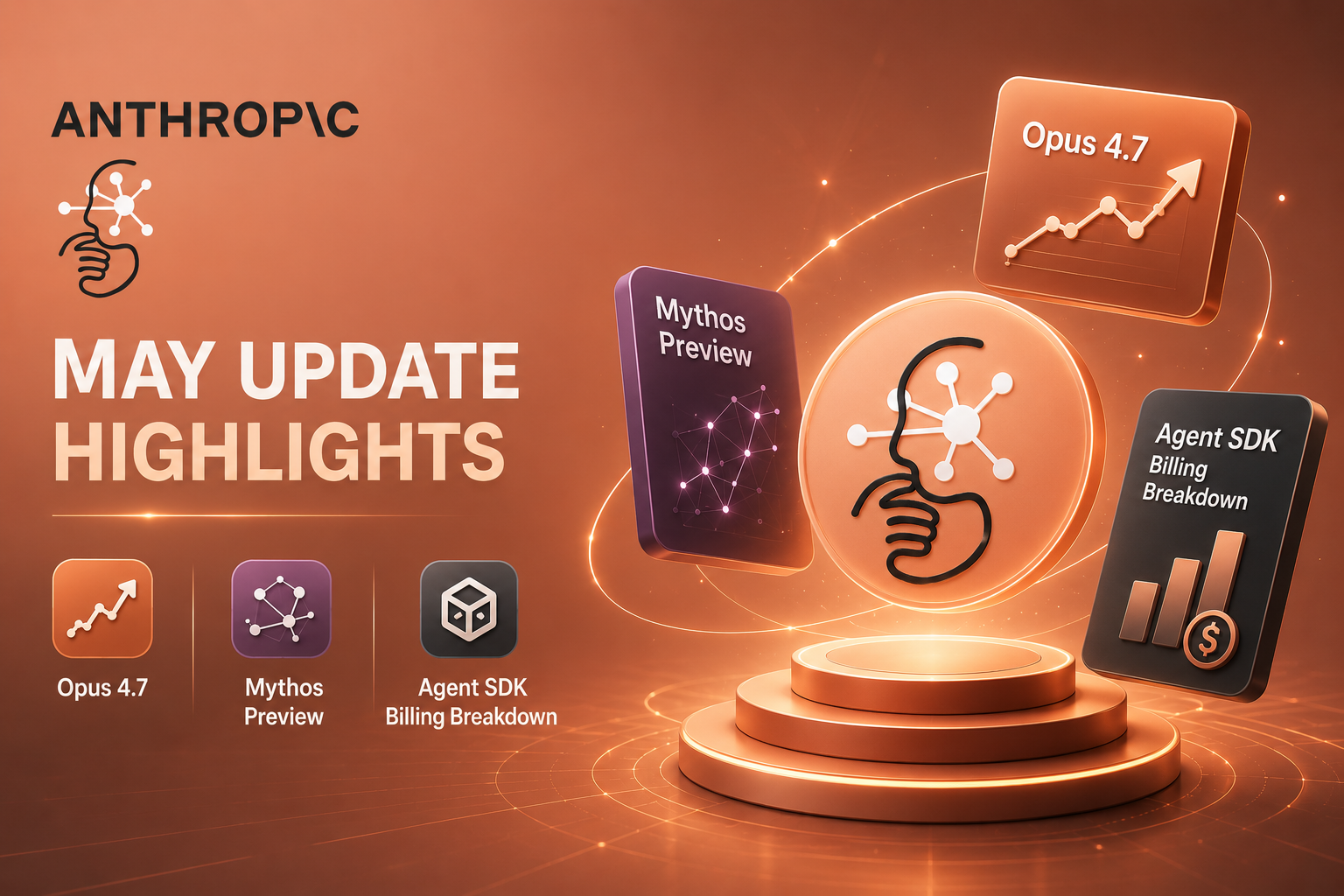
What’s covered in this issue: Anthropic dropped three major updates in April–May — Opus 4.7 went GA as the new flagship, replacing Opus 4.6; Mythos Preview was kept behind a gated research program due to its “overpowered cybersecurity capabilities”; and Agent SDK / Claude Code programmatic usage will be split out of subscription quotas into separate billing starting June 15. Here’s the full breakdown, with practical implications for developers.
1. Claude Opus 4.7 Is Generally Available — Same Price as Before

Date: 2026-04-16 Summary: Anthropic released Claude Opus 4.7, available across the API, Amazon Bedrock, Google Vertex AI, and Microsoft Foundry. Sources: Anthropic official announcement, GitHub Changelog
Opus 4.7 is the direct successor to Opus 4.6, with improvements focused on the hardest tier of software engineering tasks. Key changes highlighted in the official announcement:
- Complex, long-running tasks: Sustains multi-step reasoning reliably and proactively validates its own outputs before returning them
- Vision: Supports higher-resolution images — noticeably better at UI screenshots, presentations, and document generation
- Instruction following: Significantly more precise adherence to system prompts and constraints
Pricing remains unchanged:
| Model | Input | Output |
|---|---|---|
| Claude Opus 4.7 | $5 / M tokens | $25 / M tokens |
| Claude Opus 4.6 | $5 / M tokens | $25 / M tokens |
| Claude Sonnet 4.6 | $3 / M tokens | $15 / M tokens |
| Claude Haiku 4.5 | $1 / M tokens | $5 / M tokens |
What this means for developers:
- Opus 4.7 introduces breaking API changes relative to 4.6 — read the official migration docs before upgrading
- To switch, change the model ID to
claude-opus-4-7in your Anthropic SDK calls - The biggest gains from upgrading 4.6 → 4.7 are in complex code generation, architecture design, and ultra-long context scenarios; for lighter tasks like classification, extraction, and customer service, stick with Haiku 4.5 or Sonnet 4.6
You can access Opus 4.7 through claudeapi.com — same models, same pricing. No overseas payment methods needed.
import anthropic

client = anthropic.Anthropic(
    api_key="sk-yourClaudeAPIkey",
    base_url="https://gw.claudeapi.com"
)

response = client.messages.create(
    model="claude-opus-4-7",
    max_tokens=4096,
    messages=[{"role": "user", "content": "Summarize these meeting notes in 200 words..."}]
)

print(response.content[0].text)
import anthropic

client = anthropic.Anthropic(
    api_key="sk-yourClaudeAPIkey",
    base_url="https://gw.claudeapi.com"
)

response = client.messages.create(
    model="claude-opus-4-7",
    max_tokens=4096,
    messages=[{"role": "user", "content": "Summarize these meeting notes in 200 words..."}]
)

print(response.content[0].text)
2. Claude Mythos Preview: More Powerful, but Not Publicly Released

Date: 2026-04-07 Summary: Anthropic introduced Claude Mythos Preview — a model whose code and cybersecurity capabilities “dramatically exceed Opus 4.6” — but restricted it to a gated research preview citing safety risks, with no public release. Sources: Anthropic Red Team Blog, InfoQ coverage
Key technical specs for Mythos Preview (from the AWS Bedrock model card):
| Dimension | Spec |
|---|---|
| Context window | 1M tokens |
| Max output | 128K tokens |
| Reasoning mode | Adaptive thinking only |
| Knowledge cutoff | 2025-12 |
| Lifecycle | Preview (no EOL date) |
Published benchmark results worth noting:
- SWE-bench Verified: 93.9% (vs. 80.8% for Opus 4.6)
- Expert-level CTF challenges: 73% success rate (no model could complete these prior to April 2025)
- “The Last Ones” 32-step enterprise network attack simulation: Completed the full chain in 3 out of 10 attempts, averaging 22 steps completed
Anthropic publicly stated that during testing, Mythos Preview discovered “thousands of 0-days” across major operating systems and browsers, including a 27-year-old vulnerability in OpenBSD. It successfully reproduced 83% of known vulnerabilities on the first attempt and generated working PoC exploits.
Because of these capabilities, Anthropic restricted Mythos Preview to the Project Glasswing consortium — roughly 40 organizations including AWS, Apple, Microsoft, Google, CrowdStrike, and Palo Alto Networks, with a committed $100M in usage credits exclusively for defensive security research.
What this means for developers:
- Short-term: Mythos Preview will not appear in the standard API model list — you cannot access this model ID
- Medium-term: Opus 4.7 has already incorporated Mythos Preview’s “differential cyber capability reduction” approach during training, making it the compliant high-capability alternative
- Long-term: The signal from Anthropic is clear — frontier capabilities will increasingly follow a “research first, release later” pathway
For most developers, Opus 4.7 and Sonnet 4.6 cover the vast majority of coding, writing, and Agent tasks. Focus there.
3. Agent SDK / Claude Code Programmatic Usage Gets Separate Billing Starting June 15

Date: Policy announced 2026-05, effective 2026-06-15
Summary: Anthropic is splitting Agent SDK, claude -p, Claude Code GitHub Actions, and third-party frameworks (e.g., OpenClaw) — collectively “programmatic usage” — out of Pro / Max subscription quotas into a separate monthly credit pool.
Sources: The New Stack coverage, InfoWorld coverage
The new billing structure:
| Subscription Tier | Programmatic Usage Monthly Credits |
|---|---|
| Claude Pro ($20/mo) | $20 in credits |
| Claude Max 5x ($100/mo) | $100 in credits |
| Claude Max 20x ($200/mo) | $200 in credits |
- Original subscription quotas remain unchanged, but now only cover interactive usage (Claude Code interactive mode, Claude.ai web, Claude Cowork)
- Programmatic usage draws from the separate credit pool, priced at standard API rates
- Triggers: Agent SDK,
claude -pnon-interactive commands, GitHub Actions, third-party apps built on the Agent SDK
Why it matters: On April 4, Anthropic had already banned Pro/Max subscribers from using third-party frameworks like OpenClaw to burn through subscription quotas. This formalizes that policy into a complete billing framework. Anthropic frames it as “returning subscription quotas to genuinely interactive users.” The industry reads it as AI companies moving definitively toward metered billing — GitHub Copilot made a near-simultaneous shift to a token/credit system.
What this means for developers:
- If you only use Claude Code in interactive mode: no impact
- If you run heavy automation scripts, CI integrations, or Agent SDK tasks: starting June 15, you’ll burn through your subscription credits faster, with overages billed at API rates
- If you’re already calling the API directly: you’re already on pay-per-use billing — nothing changes
Developers using claudeapi.com are on a direct API model with no subscription credit pool concept — you pay per token consumed, with no risk of subscription loopholes being shut down.
4. Claude Platform on AWS Goes Live
Date: 2026-05 Summary: AWS became the first cloud provider to host Anthropic’s native Claude Platform directly, giving developers full access through their existing AWS accounts. Sources: AWS official announcement, The Register coverage
Bundled capabilities (most in beta):
- Messages API, Files API, Message Batches API
- Claude Managed Agents
- Advisor tool, Web Search, Web Fetch
- MCP Connector, Agent Skills, Code Execution
Billing model: Through AWS Marketplace, consumption-based, unified with your other AWS services on a single invoice. Audit through AWS CloudTrail, permissions through IAM.
What this means for developers:
- Heavy AWS users benefit most — single account, billing, audit, and security stack
- Most developers will find using the Anthropic API directly, or through a relay like claudeapi.com, more straightforward for now
5. Try It Now: Run Opus 4.7
If you’re still on Opus 4.6, switch the model ID to claude-opus-4-7 and run it against your most complex task to compare. There are breaking API changes, so before upgrading, watch out for:
- Updated field constraints on the
thinkingparameter - Changes to some
tool_useresponse structures - More granular error codes
A simple test call:
import anthropic

client = anthropic.Anthropic(
    api_key="sk-yourClaudeAPIkey",
    base_url="https://gw.claudeapi.com"
)

response = client.messages.create(
    model="claude-opus-4-7",
    max_tokens=8192,
    thinking={"type": "enabled", "budget_tokens": 5000},
    messages=[{
        "role": "user",
        "content": "Refactor this Python code, identify potential performance bottlenecks, and provide an optimized version: ..."
    }]
)

print(response.content[-1].text)
import anthropic

client = anthropic.Anthropic(
    api_key="sk-yourClaudeAPIkey",
    base_url="https://gw.claudeapi.com"
)

response = client.messages.create(
    model="claude-opus-4-7",
    max_tokens=8192,
    thinking={"type": "enabled", "budget_tokens": 5000},
    messages=[{
        "role": "user",
        "content": "Refactor this Python code, identify potential performance bottlenecks, and provide an optimized version: ..."
    }]
)

print(response.content[-1].text)
Summary
Three storylines this month:
- Models: Opus 4.7 takes over as the flagship — same price, stronger across the board. Mythos Preview stays in the research phase.
- Billing: Agent SDK programmatic usage gets its own billing pool starting June 15 — the subscription era is transitioning toward metered usage.
- Ecosystem: Claude Platform on AWS expands the enterprise on-ramp.
Access Opus 4.7 and Sonnet 4.6 through claudeapi.com — full model capabilities, standard API pricing. Direct access from anywhere, no extra configuration needed.