TL;DR: Claude is the best AI model for SEO “thinking” tasks right now - keyword clustering, content outlining, entity extraction, inventory page diagnostics, it does it all. But don’t put it on autopilot, you have to give it real data and structured constraints. In this article, we’ve compiled a list of 7 proven workflows, each with directly reusable Prompt templates. Want to get started? Click here to get the Claude API Key →
📖 reading instructions
This article is geared towards users with some SEO fundamentals who want to add Claude to their existing workflow, covering API calls, Prompt engineering, and data-driven analytics.
If you’re just starting to learn SEO and haven’t used AI tools yet, we recommend reading this introductory version first: Zero-code guide: Using Cherry Studio to access the Claude API and run through the SEO workflow →
1. 2026 Claude’s real status in the SEO world.
If you look around the SEO community on Twitter/X or r/SEO on Reddit these days, you’ll notice that the discussion has changed. Instead of asking “can Claude help me write my blog”, people are seriously talking about more in-depth ways to play with Claude - content refresh prompts, inbound map generation, intent clustering workflows, QA checklists - which is a signal that Claude’s use in SEO scenarios is maturing. is maturing.
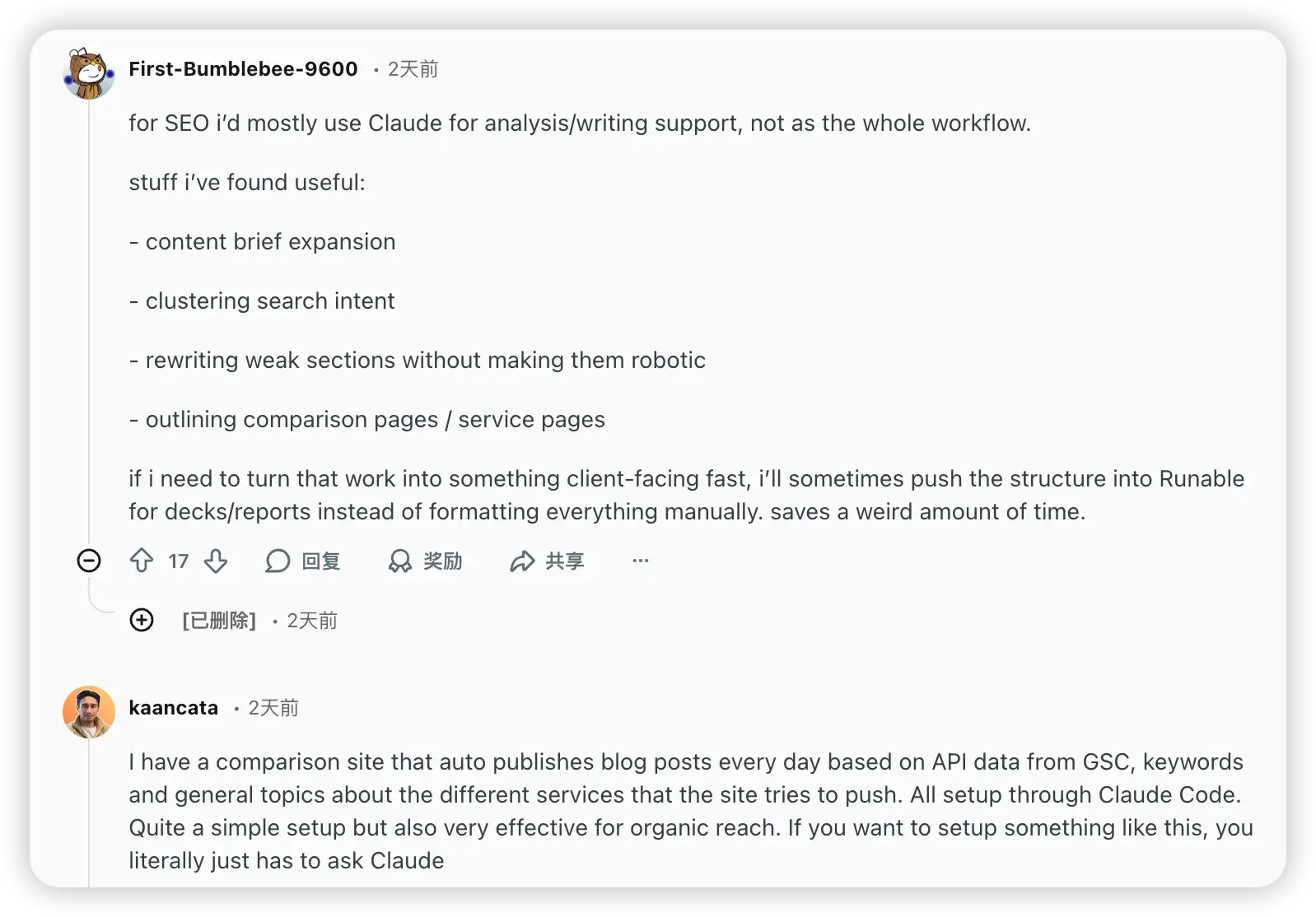 Meanwhile, the search landscape itself is undergoing a paradigm shift; Conductor's analysis of 21.9 million queries shows that Google AI Overviews now appear in more than 25% of searches. Yext's study of 17.2 million AI citations for Q4 2025 revealed an interesting pattern: the differences in content source preferences between AI platforms are quite striking - Claude is more likely to cite UGC (user-generated content) than any other model, and ChatGPT is more Wikipedia-friendly. . This means that **you can't really use one set of content playbook to eat all platforms**, and optimizing for different AI's citation preferences separately is already an inescapable topic.
On February 17, 2026, Anthropic released Claude Sonnet 4.6, and the impact of this update on actual SEO workflows is quite tangible, and worth talking about in detail:
- Adaptive Thinking: Claude automatically determines when it’s time for deep reasoning and when to produce results quickly. When running competitive analysis, it automatically invokes deep inference mode, and when generating Meta Description in batch, it is done efficiently without wasting arithmetic power.
- 1 Million Token Context Window: This means you can stuff GSC export data, 10 competitor articles, a list of URLs on the site, and a brand tone of voice guide into a single request, all in one go!
- Context Compaction**: Automatically summarizes the early parts of long conversations so that long workflows don’t lose their memory, which is critical for complex analytics tasks.
- Web Search Dynamic Filtering: Claude uses code to filter irrelevant results before they go into context, resulting in significantly better accuracy and less token consumption.
Sonnet 4.6 took first place globally on the GDPval-AA Real Office Tasks Benchmarks list with 1633 Elo, a full 27 points ahead of its flagship Opus 4.6 (1606 points) - the first time that the Sonnet family has outperformed Opus in a major benchmark, with pricing maintained at $3/$15 per million. $3/$15 per million tokens (input/output), the same as the previous Sonnet 4.5.
However, there’s one perception to calibrate before you can really get into the workflow:
**Claude is essentially an SEO analyzer trapped in a chat box. It needs you to provide real data input, it needs structured constraints, and it needs you to verify the output. **
If you think of it as a fully automated “enter keyword → output perfect SEO article” machine, there’s only one way to end up: sending out a bunch of undifferentiated content and negatively optimizing it.
The right position is to position Claude as your Advanced Content Strategy Analyst - it’s responsible for structuring, logic and direction, and you’re responsible for providing the business context and checking the answers.
2. SEO tasks that Claude is good at vs. not so good at
Before wiring the Claude API into your SEO process, calibrate expectations with this table:
| Task Type | What is Claude good at? | Description | Description | ----- | ----- | ----- | Keyword Intent Categorization | ✅ Strong | Keyword Intent Categorization | ✅ Strong | Give structured input, stable output | | SERP Alignment Outline | ✅ Strong | Need to give competing title structure | | Entity Extraction and Topic Mapping | ✅ Strong | Long text analysis has obvious advantages | | Inventory Page Refresh Program | ✅ Strong | Need to provide GSC data context | ✅ Internal Link Planning | ✅ Strong | Need to provide GSC data context | ✅ Strong | Internal Link Planning ✅ Medium Strong | Site URL List Required | Editorial QA / Fact-Checking | Editorial QA / Fact Checking ✅ Medium Strong | Manual secondary verification of data class statements required | Real-time SERP Data Pulling | Real-time SERP data pulling | ❌ Weak | Cannot crawl SERPs on its own, requires you to provide data | | Backlink Analysis | ❌ Weak | No crawling ability, need professional tools | | Keyword Search Volume/Difficulty | ❌ Weak | Data may be outdated, must use specialized tools | | Business Strategy Decisions | ❌ Weak | Don’t understand your margins, conversion funnel | | | Need first-hand experience with content | ❌ Weak | No hands-on experience, prone to disillusionment |
It’s really easy to tell: The task is inclined to “reasoning + induction + structured output”, Claude is basically competent; the task is inclined to “real-time data + crawling + quantitative indicators”, honestly go to use professional SEO tools.
3. 7 High-Value SEO Scenarios + Complete Prompts
3.1 Keyword Intent Clustering and Topic Clustering
**Why can’t this step be skipped? **
Many teams skip this step because “we already know the intent”. Then you realize that the page stuck on page 2 is fighting two different intents at the same time, or the other way around - 5 pages are fighting for the same intent, eating into each other’s traffic. These types of problems are often hard to detect and can be quite costly.
Claude can quickly categorize a keyword list of 200-1000 words into intent groups, but only if you give it real data, rather than letting it “guess” out of thin air.
Workflow: First, export the keyword list from a professional SEO tool like GSC / Ahrefs / Semrush, keep the columns of keywords, monthly searches (or exposure), and currently ranked pages, and then paste them into Claude.
📋 Reusable Prompt template:
You are a senior SEO content strategist. Please perform intent clustering on the following list of keywords.

Rules:
- Generate up to 10 clusters
- Each cluster must be clearly labeled with a "primary intent" (informational, business research, transactional, navigational, problem solving, comparative)
- Identify the most likely content formats for the SERPs (List Articles, Landing Pages, Templates, Definition Pages, Tools Pages, Comparison Pages, How-to).
- Flag as "potential cannibalization risk" if multiple clusters may map to the same URL type

Output format: Markdown table
Columns: Cluster Name | Primary Intent | SERP Format | Core Keywords | Long Tail Supporting Terms | Notes

Keyword List:
{paste your keyword list}
``

Once you get the output, focus on checking three things: are the clusters mutually exclusive? Manually verify that the SERP format recommendations are accurate for 3-5 randomly selected head terms? Are there any "microclusters" that are essentially just synonyms - if so, merge them.

---

### 3.2 SERP-Aligned Content Outline Generation

**Core Logic:** The outline determines the number of revision rounds. A good outline equals 1 round of revisions, and a poor outline equals 3 rounds of rework, so it's not hard to do the math.

The key to generating a high-quality outline for Claude is that you have to give it the H2/H3 structure** of the competition, rather than letting it guess what the SERPs look like. The difference in quality between the two inputs directly determines whether the output is crap or not.

**Workflow:**
Search for the target term in Google, open the first 5 results, copy the H2/H3 headline structure of each, plus the target reader profile, page goals, and writing constraints, and hand them over to Claude together.

**📋 Reusable Prompt template:**

``.
You're an SEO content strategist, generate SERP-aligned content outlines for the following target terms.

Target term: {keyword}
Target Readers: {Reader Profile, Example: Indie Seller with 1-3 years of experience, understands basic SEO}
Page Objective: {action or decision that the reader should complete after reading}
Constraints: avoid empty words, have real cases and data, do not fabricate statistics

Competitor title structure:
Competitive 1:
- H2: ...
- H3: ...
Competitive 2:
- H2: ...

Please generate:
1. recommendation H1 (3 alternatives)
2. full H2/H3 outline
3. annotate each H2 with: a) what problem the reader is solving, b) how we can outperform the competition (differentiated contribution)
4. which parts should be put in the conversion CTA
``

---

### 3.3 Entity Extraction and Topic Coverage Audit

This is an easily overlooked but extremely cost-effective workflow that is hard to go back to after you've done it once.

Stick a draft (or competing article) into Claude and have it extract the named entity (brand, tool, standard, person), the core concept, the subtopics that Google expects to be covered by that intent, as well as identify missing definitions and keyword stacking signals.

**📋 Reusable Prompt template:**

``.
Please analyze the following for entity extraction and topic coverage.

Target word: {keyword}

Tasks:
1. extract entities, grouped by type: product/tool, concept, metric, process, role, geography, criteria
2. list 15-20 topics that Google expects to cover for the intent "{target term}" (based on your training data, not real-time SERPs)
3. Identify topics that are missing or inadequately explained in the draft.
4. Flag words that appear too often and may signal keyword stacking.

Full draft:
{paste content}
``

By making the output an Editorial Review Checklist and going through it before each post is published, the lower limit of content quality is standardized.

---

### 3.4 Stock Page Decline Diagnosis and Refresh Program (Highest ROI Workflow)

For sites with some content buildup, refreshing stock pages can often see rankings come back faster than new pages. This is a cost-effective path, but many teams tend to ignore it.

Claude's core value in this scenario is to **take your GSC data and the current state of your pages and turn it into a prioritized list of refresh actions**. Note that if you ask Claude to make suggestions without giving you the data, all you'll get is the correct but completely useless "add examples, optimize readability" crap.

**Workflow:**
Find a page in GSC that has seen a drop in clicks of more than 15% in the last 3 months, derive the URL's relevant query terms, average rank, CTR, and the start of the drop in traffic, and then paste in the page's current outline and core paragraphs.

**📋 Reusable Prompt template:**
You are a senior SEO content strategist. Please perform intent clustering on the following list of keywords.

Rules:
- Generate up to 10 clusters
- Each cluster must be clearly labeled with a "primary intent" (informational, business research, transactional, navigational, problem solving, comparative)
- Identify the most likely content formats for the SERPs (List Articles, Landing Pages, Templates, Definition Pages, Tools Pages, Comparison Pages, How-to).
- Flag as "potential cannibalization risk" if multiple clusters may map to the same URL type

Output format: Markdown table
Columns: Cluster Name | Primary Intent | SERP Format | Core Keywords | Long Tail Supporting Terms | Notes

Keyword List:
{paste your keyword list}
``

Once you get the output, focus on checking three things: are the clusters mutually exclusive? Manually verify that the SERP format recommendations are accurate for 3-5 randomly selected head terms? Are there any "microclusters" that are essentially just synonyms - if so, merge them.

---

### 3.2 SERP-Aligned Content Outline Generation

**Core Logic:** The outline determines the number of revision rounds. A good outline equals 1 round of revisions, and a poor outline equals 3 rounds of rework, so it's not hard to do the math.

The key to generating a high-quality outline for Claude is that you have to give it the H2/H3 structure** of the competition, rather than letting it guess what the SERPs look like. The difference in quality between the two inputs directly determines whether the output is crap or not.

**Workflow:**
Search for the target term in Google, open the first 5 results, copy the H2/H3 headline structure of each, plus the target reader profile, page goals, and writing constraints, and hand them over to Claude together.

**📋 Reusable Prompt template:**

``.
You're an SEO content strategist, generate SERP-aligned content outlines for the following target terms.

Target term: {keyword}
Target Readers: {Reader Profile, Example: Indie Seller with 1-3 years of experience, understands basic SEO}
Page Objective: {action or decision that the reader should complete after reading}
Constraints: avoid empty words, have real cases and data, do not fabricate statistics

Competitor title structure:
Competitive 1:
- H2: ...
- H3: ...
Competitive 2:
- H2: ...

Please generate:
1. recommendation H1 (3 alternatives)
2. full H2/H3 outline
3. annotate each H2 with: a) what problem the reader is solving, b) how we can outperform the competition (differentiated contribution)
4. which parts should be put in the conversion CTA
``

---

### 3.3 Entity Extraction and Topic Coverage Audit

This is an easily overlooked but extremely cost-effective workflow that is hard to go back to after you've done it once.

Stick a draft (or competing article) into Claude and have it extract the named entity (brand, tool, standard, person), the core concept, the subtopics that Google expects to be covered by that intent, as well as identify missing definitions and keyword stacking signals.

**📋 Reusable Prompt template:**

``.
Please analyze the following for entity extraction and topic coverage.

Target word: {keyword}

Tasks:
1. extract entities, grouped by type: product/tool, concept, metric, process, role, geography, criteria
2. list 15-20 topics that Google expects to cover for the intent "{target term}" (based on your training data, not real-time SERPs)
3. Identify topics that are missing or inadequately explained in the draft.
4. Flag words that appear too often and may signal keyword stacking.

Full draft:
{paste content}
``

By making the output an Editorial Review Checklist and going through it before each post is published, the lower limit of content quality is standardized.

---

### 3.4 Stock Page Decline Diagnosis and Refresh Program (Highest ROI Workflow)

For sites with some content buildup, refreshing stock pages can often see rankings come back faster than new pages. This is a cost-effective path, but many teams tend to ignore it.

Claude's core value in this scenario is to **take your GSC data and the current state of your pages and turn it into a prioritized list of refresh actions**. Note that if you ask Claude to make suggestions without giving you the data, all you'll get is the correct but completely useless "add examples, optimize readability" crap.

**Workflow:**
Find a page in GSC that has seen a drop in clicks of more than 15% in the last 3 months, derive the URL's relevant query terms, average rank, CTR, and the start of the drop in traffic, and then paste in the page's current outline and core paragraphs.

**📋 Reusable Prompt template:**
You are an SEO content strategist. Please create a content refresh plan for the following URLs.
Goal: Improve click-throughs and ranking stability for these query terms through refreshing.
Page Data:
- Primary target terms: {words}
- Main words losing rankings: {word1, word2, word3}
- Current Average Ranking: {x}
- CTR: {x%}
- Start of traffic decline: {date}
- Background information: {example: competitor launched a new feature, Google algorithm update, product has been iterated}
Current Page Outline: {paste H2/H3 structure}
Please output:
- 10 refresh actions, each labeled with impact level (high/medium/low) and difficulty of implementation (high/medium/low)
- a description of each action: what to change → why it contributes to the intent → how to validate the effect at GSC
- recommended new anchor text for internal links (based on page intent only, no made-up URLs)
- recommended updated Meta Title and H1 (give 3 options) ``
3.5 Internal linking (not “more links”)
Claude works surprisingly well on internal link planning – but only if you give it your site structure. It doesn’t know your site, you have to tell it.
📋 Reusable Prompt templates:
``. Please create an internal link plan for the target page.
Target page: {URL or page title}
List of site pages (URL, page type, core topics): {paste list, example: /blog/claude-api-guide | Tutorial Articles | Claude API Access Tutorials /pricing | Pricing Page | Claude API Prices …}
Please provide:
- 10 recommended “inbound links” (other page → target page) with suggested anchor text variants and insertion locations
- 10 recommended “outgoing links” (target page → other page) with anchor text and reason for linking
- anchor text diversity: exact match anchor text no more than 2 times
- anchor text should be natural, avoid hard stacking
---

### 3.6 Content Editing QA and Fact Checking

Claude can act as an editorial assistant, automatically running through the QA process before publishing, and pulling out issues that are easy to miss in advance.

**📋 Reusable QA Prompt templates:**
---

### 3.6 Content Editing QA and Fact Checking

Claude can act as an editorial assistant, automatically running through the QA process before publishing, and pulling out issues that are easy to miss in advance.

**📋 Reusable QA Prompt templates:**
Please perform QA review on the following drafts as an SEO content editor.
Audit Criteria (Rubric):
- Intent fulfillment (0 to 5 points, give reasons)
- missing sections or unanswered reader questions 3. statements that require citation of sources (sentence by sentence)
- statements that require citation of sources (cite each sentence)
- contradictory or ambiguous statements
- internal linking opportunities (anchor text recommended, no made-up URLs)
- H1/H2 order optimization suggestions
- CTA alignment to page target or not
Full Draft: {paste content} ``
3.7 Multilingual Localization SEO Extension (with caveats)
Claude’s value in multilingual SEO isn’t just translation, it’s localization - making the content actually match the search behavior of the target market, not just grammatically correct.
One high-frequency pitfall is worth warning about: it’s easy to get “grammatically perfect but zero search volume” content by having Claude translate your English keyword strategy directly. The right approach is to provide local keywords for the target language market (not direct translations of English words), give Claude the product terminology constraints for the target market, and add 2-3 similar markets for tone of voice.
4. Two complete workflows (ready to copy)
Workflow A: Keyword List → Publishable Content Briefs
Ideal for small teams of 2-3 people, or when there is a large backlog of selections.
| Steps | Inputs | Claude Outputs | Tools | |— |— |— |— |— | Step 1: Intent Clustering | 200~1000 Keywords CSV | 6~10 Clusters + Recommended Page Types | Claude API | | Step 2: Generate Brief | Clustering + Competitor H2/H3 + Reader Profile | Full Content Brief (Intent Statement, Outline, Examples, Inline Placeholders) | Claude API | | Step 3: Content Production | Content Briefing | First Draft | Claude API / Editing | | Step 4: QA | First Draft | QA Report + Suggested Changes | Claude API | | Step 5: Fact Checking | Flagged Statements in QA Report | ✅/❌ Manual Verification | Manual | | Step 6: Publish | Final Draft | - | CMS |
Workflow B: GSC Data → Inventory Page Refresh
| Steps | Actions |
|---|---|
| Signal Collection | Missing GSC Query Terms + Ranking/CTR Changes + New Competitor Developments (manual check) |
| Refresh Plan | Use Prompt from 3.4 to bind missing query terms and page status |
| Manual Verification | Manually confirm SERP formatting changes; verify source of all “best practice” statements |
| Execute | Update Title/Meta → change corresponding query term paragraphs → add internal links |
| Tracking | GSC records date of update, look for changes after 14-28 days |
5. 2026 New Frontier: GEO / AEO Optimization + Claude Cowork
5.1 GEO and AEO: why traditional SEO isn’t enough anymore
According to Conductor, AI Overviews are already present in more than 25% of Google searches; Gartner predicts that 50% of searches will involve an AI assistant by 2028. Against this backdrop, two new optimization directions are impossible to ignore:
GEO (Generative Engine Optimization) is to make content easier to be retrieved and quoted by AI systems such as ChatGPT, Perplexity, Google AI Overviews, Claude, etc.; and AEO (Answer Engine Optimization) is to optimize for direct Q&A scenarios, so that the content can be extracted by the AI in the format of the “ideal quote”.
A few interesting data points (source: platform studies, 2025-2026):
- Ahrefs analyzed 17 million citations and found that AI prefers to cite content that was published more recently, on average 25.7% newer than traditional organic search results
- The first 30% of the body of the content (i.e., the introduction) contributed 44.2% of AI citations, while the end contributed only 24.7% (Growth Memo, February 2026)
- The difference in citations between the same brand on Grok and Claude can even be 615 times (Superlines, March 2026)
** The practical implications are straightforward: citations are citations. ** Core facts, figures and direct conclusions need to be at the top of the article, not tucked away deep in the text waiting for the reader to turn to them.
📋 GEO content self-check Prompt:
You're a GEO optimization expert. Analyze the following content to find out what's preventing it from being cited by AI platforms.

Target query: {question you want this content to answer}
Full text of content: {paste}

Analyze the dimensions:
1. are there paragraphs (≤ 3 sentences, fact-intensive) that directly answer the target query? Where is it located?
2. does the first H2 precede the core conclusion?
3. are named entities (brands, people, tools, standards) clearly labeled?
4. does it contain stand-alone statements that can be "cherry-picked" (sentences that can be understood without context)?
5. are FAQ Schema opportunity points added?
6. which paragraphs are most likely to be cited by AI? Which paragraphs are least likely to be cited by AI?

Output: list of questions + specific rewrite suggestions for each item
``

---

### 5.2 Claude Cowork: Automating SEO Workflow Upgrades

On January 12, **2026**, Anthropic released Claude Cowork, an autonomous agent running in the Claude desktop application, initially limited to Max subscribers, extended to Pro users on January 16, and on January 23 to Team and Enterprise plans, with the Windows version going live on **2026 February 10**. Enterprise plans on January 16, expanding to Pro subscribers on January 23 to cover Team and Enterprise plans, and going live for Windows on **February 10, 2026**, with the exact same functionality as macOS.

Unlike regular chat, Cowork has direct access to a local folder you specify, creates its own schedule, and then performs multi-step tasks on its own-continuing to work while you're away, without you having to keep an eye on it.

**Practical value for SEO teams:**

| Tasks | What Cowork can do |
|---|---|
| GSC Data Processing | Read CSV → Automatically categorize slipped pages → Generate Refresh Prioritization Report |
| Content Batch QA | Scan draft folders → run QA Checklist piece by piece → output summary report |
| Competitive Content Organization | Extract key information from multiple source files → merge into structured comparison table |
| | Regular Tasks | Set up automatic ranking report generation every Monday (supports periodic task scheduling) |

There are a few things to keep in mind when using this feature: Cowork consumes more tokens than normal conversations, and complex tasks will hit their usage limit faster; Pro plan users hit their limit earlier than Max users; folder permissions need to be explicitly configured, and Claude can only access directories you authorize. In addition, this feature is still in the Research Preview stage, and is still in the process of iteration.

---

## 6. Claude API Access: Code Samples

The following is the code example of calling Claude through [claudeapi.com](https://claudeapi.com). claudeapi.com is compatible with Anthropic official format, and can be directly connected in China.

### Python example (keyword clustering task)

`` Python
import anthropic

client = anthropic.Anthropic(
    api_key="your-claudeapi-key",
    base_url="https://code0.ai" # claudeapi.com proxy node
)

keywords = """
claude api, claude api price, claude api key, how to use claude api,
claude vs gpt4, claude for seo, claude content writing, anthropic claude api
"""

prompt = f"""
You are an SEO strategist. Please perform intent clustering for the following keywords.

Rules:
- Up to 8 clusters
- Each cluster is labeled: primary intent, recommended SERP format, potential cannibalization risk.
- Output Markdown table

Keywords list:
{keywords}
"""

message = client.messages.create(
    model="claude-sonnet-4-6",
    message = client.messages.create( model="claude-sonnet-4-6", max_tokens=2000,
    messages=[{"role": "user", "content": prompt}]
)

print(message.content[0].text)
``

### Python example (batch QA review)

``## Python
import anthropic

client = anthropic.Anthropic(
    api_key="your-claudeapi-key",
    base_url="https://code0.ai"
)

def seo_qa_audit(draft_content: str, target_keyword: str) -> str.
    """Perform SEO QA audit on draft articles""""

    prompt = f"""
    Please review the following draft as an SEO content editor.

    Target word: {target_keyword}

    Review Dimensions:
    1. Intent Satisfaction (0 to 5 points)
    2. missing topics (list)
    3. Sentences needing source citation (mark each one)
    4. H2 order optimization suggestions
    5. CTA alignment

    Draft:
    {draft_content}
    """

    response = client.messages.create(
        model="claude-sonnet-4-6",
        model="claude-sonnet-4-6", max_tokens=1500,
        messages=[{"role": "user", "content": prompt}]
    )

    return response.content[0].text

# Example usage
audit_result = seo_qa_audit(
    draft_content="(Paste your draft)",
    target_keyword="Claude API SEO"
)
print(audit_result)
``

### Node.js example (internal link planning)

```javascript
import Anthropic from "@anthropic-ai/sdk";

const client = new Anthropic({
  apiKey: "your-claudeapi-key",
  baseURL: "https://code0.ai",
});

const siteInventory = `
/blog/claude-api-guide | Tutorials | Claude API Access Tutorials
/pricing | pricing pages | Claude API pricing schemes
/blog/claude-vs-gpt4 | Comparison Articles | Claude vs GPT-4 Comparison
/docs/quickstart | documentation | quickstart guide
`;

async function generateInternalLinkPlan(targetPage) {
  const message = await client.messages.create({
    model: "claude-sonnet-4-6",
    max_tokens: 1500,
    messages: [
      {
        role: "user",
        content: `
Create an internal link plan for the following target pages.

Target page: ${targetPage}

Site Inventory:
${siteInventory}

Please provide:
1. 8 recommended inbound links (source page → target page + anchor text + insertion position)
2. 8 recommended outgoing links (target page → other pages + anchor text + reason)
3. Make sure the anchor text is naturally diverse
      `, }
      }, }, ], }, }, }, }, }, }, }, }, }
    ], }
  }).

  return message.content[0].text;
}

generateInternalLinkPlan("/blog/claude-for-seo").then(console.log);
``

> 💡 **Get API Key:** Visit [claudeapi.com](https://claudeapi.com) to sign up, top up 1 RMB to get 1 USD credit, support Alipay/WeChat, domestic direct connection no need to go over the wall.

---

## 7. Claude's Limitations and Risks (2026 Actual Test)

### ⚠️ Illusion problem: confident tone does not equal accurate content

Claude has the highest risk of hallucinating on the following types of output: statistics ("Studies show that X%...") , tool pricing, "Google officially said..." and the like, legal or compliance statements, and specific product feature descriptions. The more certain the tone, the more you should beware.

**Defense Prompt (added at the end of any fact-based task):**

``.
Mark all sentences that contain specific factual statements that require citation of sources.
Add [verification required] to the end of these sentences.
Do not provide your own links unless I have provided the cited sources in the prompt.
``

### ⚠️ Claude is not a SERP crawler

Claude can't "see current SERPs" unless you stick it with data. If you need real-time SERP insights, pull the data with tools like Ahrefs, Semrush, Screaming Frog, etc., and then give it to Claude to analyze.

### ⚠️ Strategic decisions still depend on people

Claude doesn't know your margins, sales cycles, reasons for user churn, or your boss's veto preferences. It's entirely possible for it to recommend an enterprise-level content strategy for a self-serve product - if you let it. You can't outsource the judgment of business direction to it.

### ⚠️ Brand tone drift

If you have 50 posts generated by a single Chat, it's only a matter of time before tone consistency breaks down. The solution is not complicated: add a branded tone example (2-3 paragraphs) at the beginning of each Prompt, use a fixed system Prompt template, and don't rewrite it every time.

---

## 8. Claude vs. specialized SEO tools: how to divide the work
| Tasks | with Claude | with professional SEO tools |

| Keyword Clustering Logic | ✅ | - |
| Competitive Outline Analysis | ✅ (after you paste the data) | - |
| Entity Extraction | ✅ | - |
| Internal Link Planning (based on the list of sites you provided) | ✅ | - |
| Edit QA | ✅ | - |
| Real-time Ranking / Traffic Data | - | ✅ GSC / Ahrefs |
| Keyword Difficulty / Search Volume | - | ✅ Semrush / Ahrefs |
| Web Crawler / Technical SEO | - | ✅ Screaming Frog |
| Outbound Link Analytics | - ✅ Majestic / Ahrefs |
| CMS Publishing Automation | - ✅ ✅ Specialized Content Platforms |

**The optimal combination for a small team is actually quite clear:**
The data layer uses GSC + Ahrefs/Semrush to pull keywords, rankings, and traffic; the analytics layer uses the Claude API to do clustering, outlining, refreshing plans, and QA; content production relies on editors to work with Claude to draft; and publishing operates directly in the CMS. Each of the four links has its own role, not mixed.

---

## 9. Frequently Asked Questions FAQ
**Q: Should I choose Claude Sonnet 4.6 or Opus 4.6 for SEO?

Sonnet 4.6 is sufficient for most SEO tasks. In the GDPval-AA Real Office Tasks Benchmark, Sonnet 4.6 scored 1633 Elo points ahead of Opus 4.6 (1606), the first time the Sonnet family has outperformed Opus in a major benchmark, at 1/5 the price ($3/$15 vs $15/$75 per million tokens). It is worth considering Opus 4.6 only in scenarios that require extremely deep reasoning, such as ARC-AGI-2 type problems or very long chain reasoning.

**Q: Does Claude's knowledge deadline affect SEO efforts? **

No. It has very little impact on "structural" tasks like keyword clustering, outline generation, and internal link planning. However, Claude's answers to time-sensitive questions like "Google's latest algorithm changes" may be outdated - it's safer to supplement these questions with a web-based search tool.

**Q: What's the difference between the Claude API and using Claude.ai directly? **

The API approach allows for batch processing, integration into workflows (Python/Node.js scripts), and tone consistency with System Prompt. For teams that need to process more than 50 pieces of content, an API is basically a must, and it's too inefficient to run them one by one on a web page.

**Q: Is the Claude API from claudeapi.com the same model as the official Anthropic? **.

Yes, claudeapi.com is Anthropic Claude's accessible proxy in China, and calls the official Claude model, not any magic version.

**Q: Will I be penalized by Google for using Claude for SEO content? **Q: Will I be penalized by Google if I use Claude for SEO content?

Google's stance is always to evaluate content quality and user value, not "AI-generated or not", and Claude-assisted content that is manually verified, has a differentiated viewpoint, and meets the search intent is not fundamentally different from handwritten content in terms of ranking. The real risk is in the "undifferentiated batch generation", not in the "AI used" itself.

**Q: How many tokens does an SEO task consume?

The reference values are as follows: keyword clustering (200 words) about 3000 tokens input + 1000 output; outline generation about 1500 tokens input + 800 output; complete article QA (2000 words draft) about 4000 tokens input + 1500 output. At claude-sonnet-4-6 pricing, the cost per task is typically less than ¥0.1.

---

## Conclusion: Use Claude right, don't overuse it!

Claude is not an SEO strategy, not a final draft, and not the arbiter of facts.

But it's good at helping you clear your mind, see patterns faster, and make better decisions - especially in the scenarios of intent clustering, outline generation, entity extraction, page refresh planning, inline link planning, and editorial QA.

The right way to use it is as an analytical assistant: give it real input, force structured output, and verify key facts yourself.

---

**Start SEO with Claude API now →**

Visit [claudeapi.com](https://claudeapi.com) to get API Key:
- ✅ Domestic direct connection, no need to climb the wall
- ✅ Charge 1 RMB = 1 USD credit, billing by volume
- ✅ Support claude-sonnet-4-6 / claude-opus-4-6 latest models.
- ✅ Compatible with Anthropic official SDK format.
You're a GEO optimization expert. Analyze the following content to find out what's preventing it from being cited by AI platforms.
Target query: {question you want this content to answer}
Full text of content: {paste}
Analyze the dimensions:
1. are there paragraphs (≤ 3 sentences, fact-intensive) that directly answer the target query? Where is it located?
2. does the first H2 precede the core conclusion?
3. are named entities (brands, people, tools, standards) clearly labeled?
4. does it contain stand-alone statements that can be "cherry-picked" (sentences that can be understood without context)?
5. are FAQ Schema opportunity points added?
6. which paragraphs are most likely to be cited by AI? Which paragraphs are least likely to be cited by AI?
Output: list of questions + specific rewrite suggestions for each item
``
---
### 5.2 Claude Cowork: Automating SEO Workflow Upgrades
On January 12, **2026**, Anthropic released Claude Cowork, an autonomous agent running in the Claude desktop application, initially limited to Max subscribers, extended to Pro users on January 16, and on January 23 to Team and Enterprise plans, with the Windows version going live on **2026 February 10**. Enterprise plans on January 16, expanding to Pro subscribers on January 23 to cover Team and Enterprise plans, and going live for Windows on **February 10, 2026**, with the exact same functionality as macOS.
Unlike regular chat, Cowork has direct access to a local folder you specify, creates its own schedule, and then performs multi-step tasks on its own-continuing to work while you're away, without you having to keep an eye on it.
**Practical value for SEO teams:**
| Tasks | What Cowork can do |
|---|---|
| GSC Data Processing | Read CSV → Automatically categorize slipped pages → Generate Refresh Prioritization Report |
| Content Batch QA | Scan draft folders → run QA Checklist piece by piece → output summary report |
| Competitive Content Organization | Extract key information from multiple source files → merge into structured comparison table |
| | Regular Tasks | Set up automatic ranking report generation every Monday (supports periodic task scheduling) |
There are a few things to keep in mind when using this feature: Cowork consumes more tokens than normal conversations, and complex tasks will hit their usage limit faster; Pro plan users hit their limit earlier than Max users; folder permissions need to be explicitly configured, and Claude can only access directories you authorize. In addition, this feature is still in the Research Preview stage, and is still in the process of iteration.
---
## 6. Claude API Access: Code Samples
The following is the code example of calling Claude through [claudeapi.com](https://claudeapi.com). claudeapi.com is compatible with Anthropic official format, and can be directly connected in China.
### Python example (keyword clustering task)
`` Python
import anthropic
client = anthropic.Anthropic(
api_key="your-claudeapi-key",
base_url="https://code0.ai" # claudeapi.com proxy node
)
keywords = """
claude api, claude api price, claude api key, how to use claude api,
claude vs gpt4, claude for seo, claude content writing, anthropic claude api
"""
prompt = f"""
You are an SEO strategist. Please perform intent clustering for the following keywords.
Rules:
- Up to 8 clusters
- Each cluster is labeled: primary intent, recommended SERP format, potential cannibalization risk.
- Output Markdown table
Keywords list:
{keywords}
"""
message = client.messages.create(
model="claude-sonnet-4-6",
message = client.messages.create( model="claude-sonnet-4-6", max_tokens=2000,
messages=[{"role": "user", "content": prompt}]
)
print(message.content[0].text)
``
### Python example (batch QA review)
``## Python
import anthropic
client = anthropic.Anthropic(
api_key="your-claudeapi-key",
base_url="https://code0.ai"
)
def seo_qa_audit(draft_content: str, target_keyword: str) -> str.
"""Perform SEO QA audit on draft articles""""
prompt = f"""
Please review the following draft as an SEO content editor.
Target word: {target_keyword}
Review Dimensions:
1. Intent Satisfaction (0 to 5 points)
2. missing topics (list)
3. Sentences needing source citation (mark each one)
4. H2 order optimization suggestions
5. CTA alignment
Draft:
{draft_content}
"""
response = client.messages.create(
model="claude-sonnet-4-6",
model="claude-sonnet-4-6", max_tokens=1500,
messages=[{"role": "user", "content": prompt}]
)
return response.content[0].text
# Example usage
audit_result = seo_qa_audit(
draft_content="(Paste your draft)",
target_keyword="Claude API SEO"
)
print(audit_result)
``
### Node.js example (internal link planning)
```javascript
import Anthropic from "@anthropic-ai/sdk";
const client = new Anthropic({
apiKey: "your-claudeapi-key",
baseURL: "https://code0.ai",
});
const siteInventory = `
/blog/claude-api-guide | Tutorials | Claude API Access Tutorials
/pricing | pricing pages | Claude API pricing schemes
/blog/claude-vs-gpt4 | Comparison Articles | Claude vs GPT-4 Comparison
/docs/quickstart | documentation | quickstart guide
`;
async function generateInternalLinkPlan(targetPage) {
const message = await client.messages.create({
model: "claude-sonnet-4-6",
max_tokens: 1500,
messages: [
{
role: "user",
content: `
Create an internal link plan for the following target pages.
Target page: ${targetPage}
Site Inventory:
${siteInventory}
Please provide:
1. 8 recommended inbound links (source page → target page + anchor text + insertion position)
2. 8 recommended outgoing links (target page → other pages + anchor text + reason)
3. Make sure the anchor text is naturally diverse
`, }
}, }, ], }, }, }, }, }, }, }, }, }
], }
}).
return message.content[0].text;
}
generateInternalLinkPlan("/blog/claude-for-seo").then(console.log);
``
> 💡 **Get API Key:** Visit [claudeapi.com](https://claudeapi.com) to sign up, top up 1 RMB to get 1 USD credit, support Alipay/WeChat, domestic direct connection no need to go over the wall.
---
## 7. Claude's Limitations and Risks (2026 Actual Test)
### ⚠️ Illusion problem: confident tone does not equal accurate content
Claude has the highest risk of hallucinating on the following types of output: statistics ("Studies show that X%...") , tool pricing, "Google officially said..." and the like, legal or compliance statements, and specific product feature descriptions. The more certain the tone, the more you should beware.
**Defense Prompt (added at the end of any fact-based task):**
``.
Mark all sentences that contain specific factual statements that require citation of sources.
Add [verification required] to the end of these sentences.
Do not provide your own links unless I have provided the cited sources in the prompt.
``
### ⚠️ Claude is not a SERP crawler
Claude can't "see current SERPs" unless you stick it with data. If you need real-time SERP insights, pull the data with tools like Ahrefs, Semrush, Screaming Frog, etc., and then give it to Claude to analyze.
### ⚠️ Strategic decisions still depend on people
Claude doesn't know your margins, sales cycles, reasons for user churn, or your boss's veto preferences. It's entirely possible for it to recommend an enterprise-level content strategy for a self-serve product - if you let it. You can't outsource the judgment of business direction to it.
### ⚠️ Brand tone drift
If you have 50 posts generated by a single Chat, it's only a matter of time before tone consistency breaks down. The solution is not complicated: add a branded tone example (2-3 paragraphs) at the beginning of each Prompt, use a fixed system Prompt template, and don't rewrite it every time.
---
## 8. Claude vs. specialized SEO tools: how to divide the work
| Tasks | with Claude | with professional SEO tools |
| Keyword Clustering Logic | ✅ | - |
| Competitive Outline Analysis | ✅ (after you paste the data) | - |
| Entity Extraction | ✅ | - |
| Internal Link Planning (based on the list of sites you provided) | ✅ | - |
| Edit QA | ✅ | - |
| Real-time Ranking / Traffic Data | - | ✅ GSC / Ahrefs |
| Keyword Difficulty / Search Volume | - | ✅ Semrush / Ahrefs |
| Web Crawler / Technical SEO | - | ✅ Screaming Frog |
| Outbound Link Analytics | - ✅ Majestic / Ahrefs |
| CMS Publishing Automation | - ✅ ✅ Specialized Content Platforms |
**The optimal combination for a small team is actually quite clear:**
The data layer uses GSC + Ahrefs/Semrush to pull keywords, rankings, and traffic; the analytics layer uses the Claude API to do clustering, outlining, refreshing plans, and QA; content production relies on editors to work with Claude to draft; and publishing operates directly in the CMS. Each of the four links has its own role, not mixed.
---
## 9. Frequently Asked Questions FAQ
**Q: Should I choose Claude Sonnet 4.6 or Opus 4.6 for SEO?
Sonnet 4.6 is sufficient for most SEO tasks. In the GDPval-AA Real Office Tasks Benchmark, Sonnet 4.6 scored 1633 Elo points ahead of Opus 4.6 (1606), the first time the Sonnet family has outperformed Opus in a major benchmark, at 1/5 the price ($3/$15 vs $15/$75 per million tokens). It is worth considering Opus 4.6 only in scenarios that require extremely deep reasoning, such as ARC-AGI-2 type problems or very long chain reasoning.
**Q: Does Claude's knowledge deadline affect SEO efforts? **
No. It has very little impact on "structural" tasks like keyword clustering, outline generation, and internal link planning. However, Claude's answers to time-sensitive questions like "Google's latest algorithm changes" may be outdated - it's safer to supplement these questions with a web-based search tool.
**Q: What's the difference between the Claude API and using Claude.ai directly? **
The API approach allows for batch processing, integration into workflows (Python/Node.js scripts), and tone consistency with System Prompt. For teams that need to process more than 50 pieces of content, an API is basically a must, and it's too inefficient to run them one by one on a web page.
**Q: Is the Claude API from claudeapi.com the same model as the official Anthropic? **.
Yes, claudeapi.com is Anthropic Claude's accessible proxy in China, and calls the official Claude model, not any magic version.
**Q: Will I be penalized by Google for using Claude for SEO content? **Q: Will I be penalized by Google if I use Claude for SEO content?
Google's stance is always to evaluate content quality and user value, not "AI-generated or not", and Claude-assisted content that is manually verified, has a differentiated viewpoint, and meets the search intent is not fundamentally different from handwritten content in terms of ranking. The real risk is in the "undifferentiated batch generation", not in the "AI used" itself.
**Q: How many tokens does an SEO task consume?
The reference values are as follows: keyword clustering (200 words) about 3000 tokens input + 1000 output; outline generation about 1500 tokens input + 800 output; complete article QA (2000 words draft) about 4000 tokens input + 1500 output. At claude-sonnet-4-6 pricing, the cost per task is typically less than ¥0.1.
---
## Conclusion: Use Claude right, don't overuse it!
Claude is not an SEO strategy, not a final draft, and not the arbiter of facts.
But it's good at helping you clear your mind, see patterns faster, and make better decisions - especially in the scenarios of intent clustering, outline generation, entity extraction, page refresh planning, inline link planning, and editorial QA.
The right way to use it is as an analytical assistant: give it real input, force structured output, and verify key facts yourself.
---
**Start SEO with Claude API now →**
Visit [claudeapi.com](https://claudeapi.com) to get API Key:
- ✅ Domestic direct connection, no need to climb the wall
- ✅ Charge 1 RMB = 1 USD credit, billing by volume
- ✅ Support claude-sonnet-4-6 / claude-opus-4-6 latest models.
- ✅ Compatible with Anthropic official SDK format.