I. 30 seconds to understand how much Claude API really costs
Claude API is billed in Token, with three price tiers for three models - **Haiku ($1/$5) the king of price/performance, Sonnet ($3/$15) the golden balance, and Opus ($5/$25) the flagship intelligence **all in millions of Token (MTok).
Official latest pricing: Opus 4.6 $5/MTok input, $25/MTok output; Sonnet 4.6 $3/MTok input, $15/MTok output; Haiku 4.5 $1/MTok input, $5/MTok output.
<img src=“/blog/claude-api-pricing-guide/claude-api-pricing-overview-2026.png” alt=“Claude official API 2026 latest pricing overview” width=“1806” height=“1146” / >
** What does being at claudeapi.com mean? ** 1 RMB = 1 USD API credit. With the most commonly used Sonnet 4.6, for example, 1 RMB can handle about 130,000 input Token (about 100,000 Chinese characters), enough to analyze half a novel. claude 4.5 series achieved 67% cost reduction compared to its predecessor. claudeapi.com converts it to RMB at a rate of 2.5, so it’s straightforward to see and count.
** Is that 2.5x expensive? ** Not at all. The current real exchange rate is about 6.9:1, if you connect directly to the official settlement in USD, Opus inputs $5/MTok = ¥34.5/MTok, while claudeapi.com ** is only ¥12.5/MTok - equivalent to a 3.6% discount, a combined saving of about 64%. **Factor in credit card fees and internet charges, and you’ll save even more.
**You’ve got the best time to get in on the action. ** You’ve caught the best time to get in.
The original Claude 3 Opus was priced at $15/$75 per million Token, now Opus 4.6 is only $5/$25, a 67% drop.
At the same time, the modeling capabilities have jumped dramatically - each generation delivers more intelligence for less money.
II. claudeapi.com Billing rules: so simple that you don’t need a calculator
Searching for prices you must be wondering: how does this platform charge? Are there any hidden fees? The answer is - NO.
2.1 Core rules: official USD price × 2.5x, RMB direct payment
- **How to calculate? ** All models price = Anthropic official USD price × 2.5, in RMB.
- ** Why do I save money? ** Because the equivalent exchange rate is only 2.5:1, far better than the real rate ~6.9:1, ** combined savings of about 64% **
- Supports Alipay / WeChat recharge, no overseas credit card required
- No Monthly Fee, No Subscription, No Minimum Consumption - Pure Pay Per View
💡 One sentence to understand: you use ¥12.5 to buy API service worth $5 (≈ ¥34.5), but far cover the exchange rate difference, network cost and payment barrier.
2.2 What is a Token? How does it work?
Token is the basic unit of text processing in a large language model.
The Claude API prices input Token (what you send to Claude) and output Token (what Claude replies to) separately.
Output tokens are priced 5x as much as inputs, so the length of the reply is often the biggest cost lever.
Rough estimate: 1 Token ≈ 4 English characters or 0.75 English words; for Chinese, about 1 Token ≈ 1-2 Chinese characters.
The output token cost is usually 3-5 times of the input. In the current three main models, the output price is exactly 5 times the input - Controlling the length of replies is the most direct way to save money.
Practical example: You use Sonnet 4.6 to send a 200-word Chinese question about a programming problem (about 200 Token input), and Claude replies with 500 words of code (about 500 Token output):
- Input cost: 200 Token × ¥7.5/MTok = ¥0.0015
- Output cost: 500 Token × ¥37.5/MTok = ¥0.01875
- Total about ¥0.02 ≈ 2 cents
2.3 Cost Transparency: Real-time Usage Viewing
The usage object returned by the API reports the number of input and output tokens used in this request, down to the token level. You can view the history of consumption details in the backend of claudeapi.com, and also support setting budget limit alarms, so you don’t have to worry about overspending.
III. 2026 Claude Full Model Price List
3.1 Master Model Pricing at a Glance (per million Token / USD)
| Models | Input Pricing | Output Pricing | Cache Writes (5 minutes) | Cache Reads | Suitable Scenarios | | ------|---------|---------|-----------------|---------|---------|---------| | Haiku 4.5 | $1 | $5 | $1.25 | $0.10 | High-frequency light tasks | | Sonnet 4.6 | $3 | $15 | $3.75 | $0.30 | Generic Master Model | | Opus 4.6 | $5 | $25 | $6.25 | $0.50 | Flagship Complex Inference |
Data source: Anthropic official pricing page, verified March 2026. https://platform.claude.com/docs/zh-CN/about-claude/pricing
Tip Cache Pricing: 5-minute cache writes are 1.25x the base input price, 1-hour cache writes are 2x, and cache reads are only 0.1x the base price.
3.2 claudeapi.com Chinese Yuan Conversion Table
| Models | How many input Token can be bought with 1 Yuan | How many output Token can be bought with 1 Yuan | Approximate cost of a daily conversation |
|---|---|---|---|
| Haiku 4.5 | 1,000,000 | 200,000 | ≈ $0.01 |
| Sonnet 4.6 | 330,000 | 67,000 | ≈ $0.03 |
| Sonnet 4.6 | 330,000 | 67,000 | ≈ $0.03 |
Estimated at 200 Token input + 500 Token output for a daily conversation.
3.3 Key Pricing Details (Pitfall Avoidance Guide)
**✅ Opus 4.6 and Sonnet 4.6: flat pricing for all 1M contexts **
This is the biggest March 2026 good news.
Claude Opus 4.6 and Sonnet 4.6 now support a full 1M Token context window with standardized pricing - $5/$25 (Opus) and $3/$15 (Sonnet), with the same per-context pricing for a 900K Token request as for a 9K Token request. A 900,000 Token request and a 9,000 Token request are billed at the same unit price.
There is no long context premium.
⚠️ 200K threshold for older Sonnet 4.5
Sonnet 4.5 supports up to 1M Token contexts, but requests exceeding 200K input tokens will be billed at a premium: $6 input, $22.50 output per million tokens.
If you are still using Sonnet 4.5, we recommend migrating to Sonnet 4.6 as soon as possible.
**💡 Output is 5x more expensive than Input
Output Token is usually 3-5 times more expensive than input.
In the current three main models, the output price is exactly 5 times the input. This means that controlling the length of replies is the most direct way to save money.
**🧠 Extended Thinking / Adaptive Thinking
Key details: Token generated by Extended Thinking is billed at the output Token price, not a separate pricing tier.
Once enabled, you should monitor the token consumption, and it is recommended to set a reasonable budget for thinking.
IV. Model Selection Decision Tree: Don’t choose the expensive one, choose the right one.
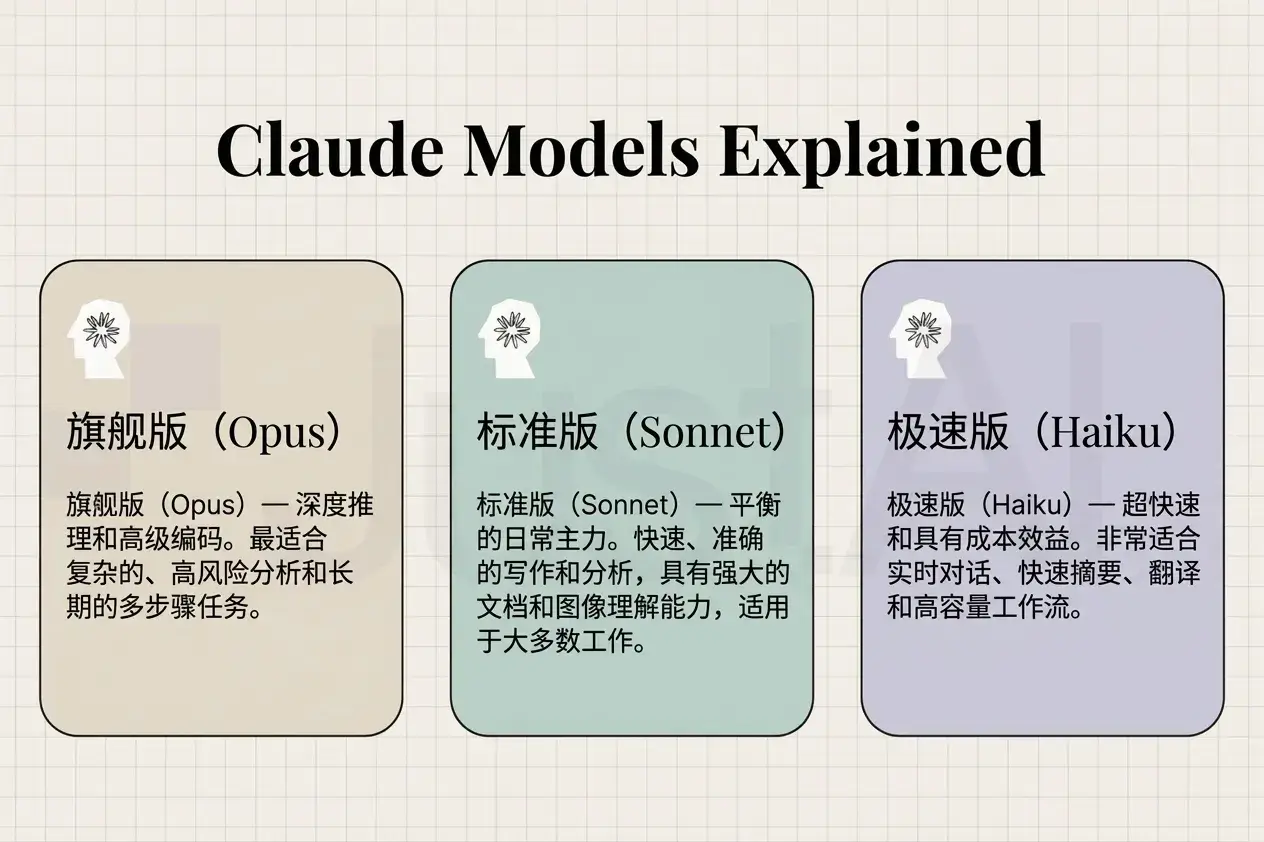
The biggest misunderstanding of model selection is “choose the most expensive one at a time”. In fact, 80% of the daily tasks with Sonnet is more than enough.
4.1 A chart to read: Which model should you use?
What are your tasks? │ ├─ Simple categorization / information extraction / short quiz / translation │ → Haiku 4.5 (¥2.5/¥12.5) - Fastest speed and lowest cost! │ ├─ Daily Programming / Content Creation / Document Analysis / Customer Service │ → Sonnet 4.6 (¥7.5/¥37.5) - Golden price/performance ratio, the best choice for most people! Sonnet 4.6 (¥7.5/¥37.5) └─ Complex Architecture Design / Deep Reasoning / Extremely Long Documentation / Agent Workflow │ └─ Complex Architecture Design / Deep Reasoning / Extremely Long Documentation / Agent Workflow → Opus 4.6 (¥12.5/¥62.5) - Flagship intelligence, complex tasks in one go!
4.2 Detailed by Scenario
🟢 Everyday dialog / translation / summary → Haiku 4.5
Haiku is suitable for high-frequency simple tasks: categorization, information extraction, short quizzes.
It is the fastest and cheapest option, ideal for high-volume, low-complexity tasks such as categorization, entity extraction, short summaries, and routing decisions.
- 10,000 simple conversations per month at a cost of about ¥30
- claudeapi.com recommended top-up: ¥50 to start, enough for 2-3 months for light users
🟡 Programming aids / content creation / data analysis → Sonnet 4.6
Sonnet 4.6 is the optimal balance for most applications, offering powerful reasoning at a reasonable price point, and is the best default choice for chatbots, content generation, and general-purpose tasks.
Sonnet 4.6’s price/performance ratio is most prominent in production-grade usage
- Monthly consumption ¥100-500 range
- claudeapi.com Recommended Recharge: ¥100-200, sweet range for developers / creators
🔴 Complex Reasoning / Agent Automation / Millions of Contexts → Opus 4.6
Both Opus 4.6 and Sonnet 4.6 support the 1 Million Token Context Window and the Extended Thinking feature; Opus 4.6 supports up to 128K output Token and Sonnet 4.6 supports 64K.
For tasks that require the deepest reasoning - such as codebase refactoring and multi-agent coordinated workflows - Opus 4.6 remains the strongest option.
- Monthly consumption ¥500+ range
- claudeapi.com Recommended Recharge: ¥500+, Heavy Users / Enterprise Users
4.3 Mixed-use strategies: smart people don’t use just one model
The right strategy is not to pick one, but to mix them intelligently. Make Sonnet the default choice for 80% of your work, and upgrade to Opus for the 20% of difficult tasks only when you need it.
Practical program:** Haiku as primary screen → Sonnet as primary → Opus to handle critical decisions**
Don’t use Opus when Sonnet is adequate, or Sonnet when Haiku is competent.
A 70/20/10 split (Haiku/Sonnet/Opus) saves 60% of the cost compared to using Sonnet exclusively.
V. Four Money-Saving Tips: Spend Half as Much for the Same Results
For those of you searching for “Claude API cheap”, this paragraph was written for you. The good news is - the following savings percentages are not affected by the 2.5x rate, because the discount is applied proportionally to the base price.
5.1 🏆 Prompt Caching - up to 90% savings
Prompt caching reduces cost and latency by reusing the processed portion of a prompt across API calls, reading from the cache for a fraction of the standard input price.
**How much does it save? **
5-minute cache writes are 1.25x the base input price, 1-hour caches are 2x, and cache reads are only 0.1x.
Cache hits = savings of 90%.
Take Sonnet 4.6 for example: standard input ¥7.50/MTok → cache reads only ¥0.75/MTok.
Enable: add a cache_control field at the top of the request, the system will manage cache breakpoints automatically.
Zero additional configuration.
**What scenarios are best suited? **
System prompts that remain constant across multiple requests, repeated references to the same document in a RAG system, early rounds in a dialog history that don’t change, and few-shot examples that are included in every call - these are all scenarios where caching is best used.
**claudeapi.com How do I turn it on? **
Just add a cache_control field at the top of the request, and the system will automatically apply cache breakpoints to the last cacheable content block.
Zero additional configuration cost.
Applicable Scenarios:
Large-scale content generation, data processing pipelines, document analysis, and other workloads that do not require real-time response.
Most batches are completed within 1 hour and results are returned in up to 24 hours.
5.3 Cache + Batch Overlay: Theoretical savings of up to 95%.
Batch API and Prompt Caching discounts can be stacked. Used in combination, they provide significant cost savings over standard API calls.
For example, in Sonnet 4.6, standard input is $3/MTok:
- After Batch: $1.50/MTok (50% savings)
- Stacked with cached reads (0.1x): $0.15/MTok (90% savings on top of Batch discount)
- Over 95% combined savings
5.4 Controlling Output Length + Streamlining Prompts
Cache and batch discounts apply at standard rates, and both can be stacked!
Take Sonnet 4.6 input as an example:
- Standard rate: ¥7.50/MTok
- After Batch: ¥3.75/MTok (save 50%)
- And then stacked cache read (× 0.1): ** ¥ 0.375/MTok ** (combined savings of 95%)
Hands-on suggestion:
- Explicitly request a “concise response” or “limit to X words” in the Prompt.
- Use structured output (JSON schema), eliminating redundant text through instrumentation or enumerated fields.
- Optimize context size to include only necessary background information and discard unneeded history
📊 Summary of money-saving effects
| Optimization | Savings | Scenarios | Getting Started Difficulty | |---------|---------|---------|---------|---------| | Mixing Models | 60-80% | All Scenarios | ⭐ Simple | | Control Output Length | 30-50% | All Scenes | ⭐ Easy | | Prompt Caching | Up to 90% | Repeat Prompt Scenes | ⭐⭐ Medium | | Batch API | 50% | Non-Real-Time Tasks | ⭐⭐ Medium | | Cache + Batch Stacking | up to 95% | Large Scale Batch Processing | ⭐⭐⭐⭐⭐⭐⭐⭐⭐⭐⭐⭐⭐⭐ Advanced |
VI. vs Official Direct Connections: Why Domestic Users Choose claudeapi.com
We don’t disparage Anthropic officially - it’s one of the best AI companies out there. But there are a series of real pain points for mainland Chinese users to connect directly to the official one.
6.1 Comparison table
| Comparison Items | Anthropic Official Direct Connect | claudeapi.com |
|---|---|---|
| Payment Methods | Overseas Credit Cards Only (Visa/Master) | Alipay/WeChat, RMB Direct Charge |
| API Pricing | USD price (e.g. Opus input $5/MTok) | CNY price (e.g. Opus input ¥12.5/MTok) |
| Actual CNY Cost | $5 × 6.9 = ¥34.5/MTok + Handling Fee | ¥12.5/MTok (incl. 2.5x Service Fee) |
| Combined savings | - | Approx. 64% |
| Network Environment | Scientific Internet access required, unstable latency | Domestic direct connection, low latency and stability |
| Account Risk | IP anomaly may trigger the wind control | Stable service, no sealing risk |
| Minimum Charge | Credit Card Binding Required | Flexible Charge, Small Starts |
| Model Support | All Claude Models | All Claude Models |
| API Compatibility | Native API | Fully compatible with native API formats |
6.2 Accounting for Hidden Costs
Let’s say you use the equivalent of $100 of API calls per month:
| Cost items | Official Direct Connect | claudeapi.com |
|---|---|---|
| API Fee | $100 × 6.9 = ¥690 | $100 × 2.5 = ¥250 |
| Credit Card Processing Fee (~2%) | ¥14 | ¥0 |
| VPN / Scientific Internet Access | ¥50-100/month | ¥0 |
| Risk of exchange rate fluctuation | ~3-5% | Fixed multiplier, no fluctuation |
| Total Monthly Cost | ¥754-804+ | ¥250 |
| Annual savings | - | Approximately ¥6,000-6,600 |
Conclusion: claudeapi.com’s 2.5x rate is much lower than the actual exchange rate of ~6.9:1, and the combined cost is still only approximately 1/3 of the official direct connection.
6.3 Zero cost of access
Fully compatible with Anthropic native API format, just replace base_url. The existing code can be migrated with one line change, and supports all major development frameworks and SDKs:
``python
Just change this line
client = anthropic. api_key=“your-claudeapi-key”, base_url=“https://api.claudeapi.com” # Replace with claudeapi.com ) ``
VII. Description of business volume discounts
7.1 Anthropic Official Corporate Programs
Anthropic offers two purchase models: a subscription plan with a fixed monthly fee and API billing based on Token usage.
Step discounts are available for high-usage users, but require an overseas subject, English communication, and US dollar billing.
7.2 claudeapi.com Enterprise Programs
- Extra bonus/discount for large recharge (Further reduce the equivalent cost of 2.5x rate)
- Support Corporate Transfer + Invoicing
- Exclusive customer service in Chinese, fast response to technical problems
- Support for multiple sub-account management, accounting for usage by department
- Contact Us: Add enterprise customer service WeChat by sweeping the code, or send an email to the customer service mailbox.
VIII. How much to recharge? Three kinds of user profiles of the recharge recommendations
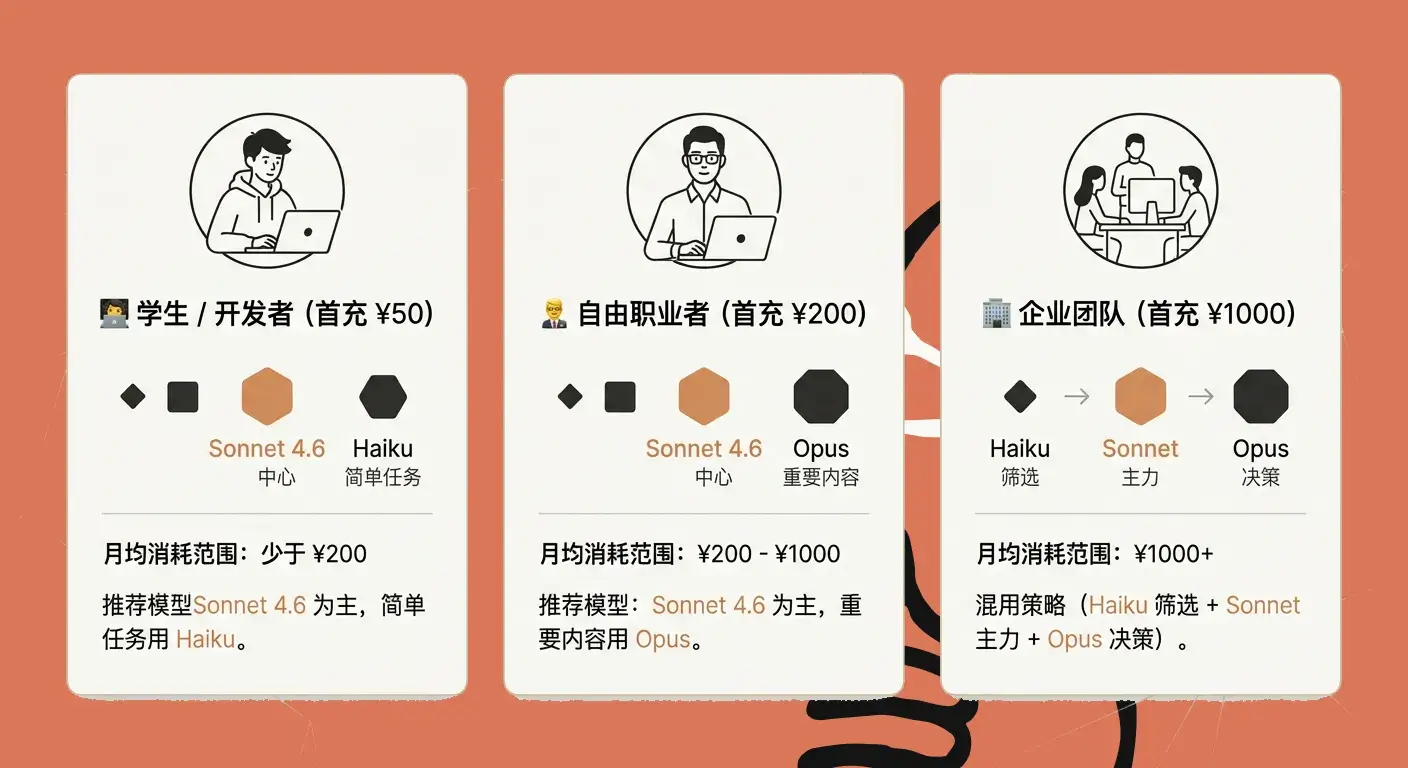 Don't hesitate to match it to your situation:
🧑💻 Individual Developer / Student
- Recommended model: Sonnet 4.6 is the main one, use Haiku for simple tasks.
- Average monthly consumption: ¥30-100
- Recommended First Charge: ¥50 (run through the process first, then add more as needed)
- 50 bucks is enough to handle 1,600+ daily conversations with Sonnet.
👨💼 Freelancer / Content Creator
- Recommended model: Sonnet 4.6, Opus for important content.
- Average monthly consumption**: ¥100-500
- Recommended first charge: ¥200 (covers 2-4 weeks of intense use)
- Typical production grade applications using Sonnet 4.6 with cache optimization typically spend between $30-100 per month.
🏢 Enterprise Teams / Technical Teams
- Recommendation Model: Hybrid Strategy (Haiku Filtering + Sonnet Primary + Opus Decision Making)
- Average Monthly Consumption: ¥1,000+
- Recommended first charge: ¥1,000 (contact customer service for corporate discounts)
IX. Frequently Asked Questions FAQ
**Q1: Which is cheaper, Claude API or ChatGPT API? **
Depends on the model gear.
Claude is positioned as a high-end API in 2026 - with a higher price per Token than OpenAI or DeepSeek, but offering best-in-class instruction adherence and inference.
At claudeapi.com’s 2.5x rate, the out-of-pocket cost in RMB may instead be lower than buying GPT-4o through the real exchange rate.
Claude is very competitively priced for a flagship in its class.
**Q2: Will the claudeapi.com credit expire? **
It does not expire. It is permanently valid after recharging and will be deducted as much as you use.
**Q3: How to enable Prompt Caching? **Q3: How do I turn on Prompt Caching?
Just add a cache_control field at the top of the request body. The system will automatically apply cache breakpoints to the last cacheable content block.
No need for complex configuration, just one line of code.
**Q4: Does Extended Thinking charge extra? **.
There is no separate charge, but Extended Thinking Token is billed at the standard output Token price. Token used for internal reasoning in the Token budget set at enablement is billed at the standard output rate for that model.
**Q5: How many times can I use $1? **
Take the most commonly used Sonnet 4.6 as an example: $1 = about 130,000 input Token or 27,000 output Token. based on 200 Token input + 500 Token output for each conversation, $1 ≈ process about 50 daily conversations, enough for a day of light use.
**Q6: Is there any extra cost for 1M contexts in Opus 4.6 and Sonnet 4.6? **
No!
Standard pricing now applies to the entire 1M context window with no long context premium.
This is the latest March 2026 policy update.
**Q7: Is there a discount for large corporate top-ups? **.
Yes. Contact claudeapi.com customer service for exclusive corporate offer, reduced equivalent multiplier for large recharge, support for public transfer and invoicing.
Now is the best time to enter
Claude Opus 4.5 levels of flagship performance at a 67% cost reduction over the previous generation.
Plus, with claudeapi.com, you’re saving another 64% over the official direct connection, so you’re getting real AI power for every dollar you spend.
Start with a ¥50 charge at claudeapi.com and run through your first API call in 5 minutes.
👉 Recharge Now | 📖 View API Documentation | 💬 [Contact Enterprise Customer Service](https:// claudeapi.com/contact)
*Data last calibrated March 2026, pricing information from Anthropic official documents. claude API prices are subject to change based on official adjustments, so we recommend checking claudeapi.com regularly for the most up-to-date information. *Claude API prices are subject to change as official adjustments are made.