SpaceX IPO Filing Reveals Anthropic Pays $1.25 Billion Per Month for Compute — On Track for First Profitable Quarter in Q2
The two most valuable numbers in AI this week both belong to Anthropic: first, the “$1.25 billion per month” compute contract disclosed in SpaceX’s IPO filing, and second, the $10.9 billion Q2 revenue forecast Anthropic shared with investors. Together, these two data points put a critical question on the table — Claude’s supply capacity and unit economics for H2 2026 are being simultaneously defined by both of these lines.
1. SpaceX’s S-1 Reveals Anthropic’s Massive Compute Deal
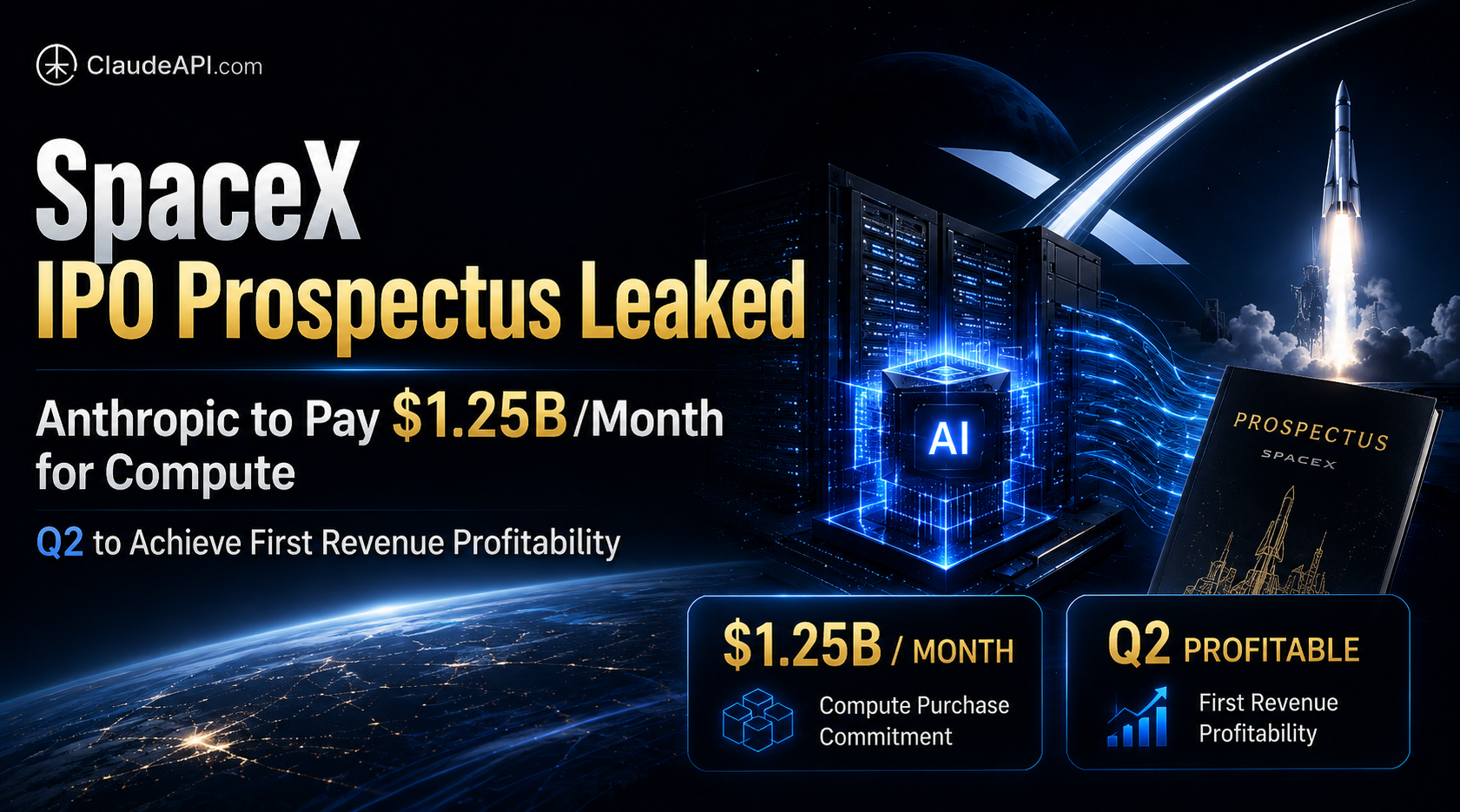
Date: May 20, 2026 Summary: SpaceX filed its S-1 with the SEC, targeting a June listing on Nasdaq under ticker SPCX at a $1.75 trillion valuation. The “Related Party Transactions” section discloses that Anthropic has signed a compute procurement agreement with SpaceX, paying approximately $1.25 billion per month, with the contract extending through May 2029, for a total of approximately $45 billion. Source: SpaceX S-1 filing; corroborated by The Information and multiple outlets on May 21.
Annualized, this single contract moves roughly $15 billion per year from Anthropic to SpaceX — nearly equal to SpaceX’s total standalone revenue for 2025. In other words, this one contract from Anthropic creates a cash inflow equivalent to SpaceX’s entire core business.
This translates the vague “partnership with SpaceX” language from Anthropic’s May 6 announcement about “increasing usage limits and reaching a compute agreement with SpaceX” into concrete numbers. At the time, the only detail was “gaining access to 300+ MW of new capacity at the Colossus 1 data center,” with no dollar figure. After the S-1 disclosure, the industry realized this is a long-term commitment on par with OpenAI’s annual compute spend.
What this means for developers:
- Claude API supply stability will improve significantly. Anthropic’s Q1 issues — frequent rate limiting and latency spikes — were primarily caused by compute capacity ceilings. A $45 billion long-term compute commitment means Claude’s token throughput ceiling will continue expanding from H2 2026 through 2027.
- It may also constrain room for price cuts. Compute is a fixed cost; to amortize a commitment this large, Anthropic will be more cautious about aggressive price reductions than OpenAI or Google — don’t expect significant Sonnet/Opus price drops in the near term.
2. Anthropic Q2 Revenue Hits $10.9 Billion, Approaching First Quarterly Profit
Date: May 21, 2026 Summary: The Wall Street Journal reports that Anthropic disclosed Q2 financial projections to investors in new fundraising materials. Source: Wall Street Journal, May 21; corroborated by multiple secondary outlets.
| Metric | Q1 2026 | Q2 2026 (Projected) | Change |
|---|---|---|---|
| Quarterly Revenue | $4.8B | $10.9B | +130% |
| Compute Cost / Revenue | $0.71 / dollar | $0.56 / dollar | -15 points |
| Quarterly Operating Profit | Negative | ~$559M | First time positive |
This is the first time in Anthropic’s history that internal projections show a positive quarterly operating profit. Combined with Sacra’s April report of “$43 billion annualized revenue,” this company has scaled revenue from $900 million to $43 billion in 18 months, with marginal cost structure improving rapidly.
What this means for developers:
- The compute cost ratio dropping from 71% to 56% is driven by the unit compute cost reduction from the SpaceX long-term contract + rising share of high-margin revenue from Claude Code and enterprise tiers.
- Positive profitability gives Anthropic a stronger hand at the IPO negotiation table — the new funding round at a $900 billion valuation (per Sacra data) barely needs to “sell a story” anymore.
- For developers, this means API prices are even less likely to drop in the short term — a company that’s already profitable won’t trade margin for market share via price wars.
3. Connecting the Dots: Anthropic Is Locking Down the Supply Side
Viewed together, these two pieces of news reveal two sides of the same strategy Anthropic executed in May 2026:
- One side is locking down supply — signing the SpaceX long-term contract, the 10-year $100 billion deal with AWS, and the $50 billion U.S. infrastructure initiative with Fluidstack — using capital to flatten the “can’t generate tokens fast enough” bottleneck that defined Q1.
- The other side is achieving positive unit economics — using enterprise tiers, Claude Code, and vertical industry solutions to drive high-margin revenue, allowing compute costs to be amortized at scale.
With the supply side locked in, Anthropic’s key variable for H2 shifts from “can we keep up” to “how big can we scale.” The two changes Claude API users will notice: rate limits getting progressively more generous, and rate throttling on high-compute models like Opus 4.7 becoming increasingly rare.
4. Other Notable Developments This Week
- OpenAI secretly filed its S-1 on May 22. Annualized revenue of $25 billion, valuation of $852 billion. Racing to IPO in the same window as Anthropic — H2 2026 will be the AI industry’s “IPO year.”
- Google I/O 2026 launched Gemini 3.5 Flash (priced at 1/2 to 1/3 of comparable frontier models) and Gemini Spark agent. Pichai directly targeting Anthropic/OpenAI’s cost structure.
- White House AI Executive Order delayed again (originally set for signing May 21); significant internal disagreement over “voluntary framework vs. mandatory NSA testing.” New signing date TBD.
- Karpathy joined Anthropic’s pretraining team on May 19.
5. What This Means for Developers Using the Claude API
Changes you’ll notice in the short term (next 1–3 months):
- Rate limits will continue loosening. The frequent 429 errors from Q1 will decrease significantly.
- Opus 4.7 / 1M context and other high-compute features will stabilize. Features that were throttled due to Q1 capacity constraints will return to normal capacity.
- Prices staying flat is the most likely scenario. Compute capacity is growing, but Anthropic needs to amortize a massive commitment + is already near profitability — there’s little incentive to proactively cut prices.
- Enterprise customers get priority. Anthropic views enterprise accounts (KPMG, PwC, Salesforce, L’Oréal, etc.) as high-margin anchor customers, and resources will be allocated accordingly. Individual developers will see continued experience improvements, but priority comes after enterprise.
If your product was delayed in Q1 due to Claude rate limiting, these two pieces of news are good news — capacity anxiety will ease in H2.
Summary
One line in SpaceX’s IPO filing puts Anthropic’s true compute spend on the table: $45 billion over 3 years — the equivalent of building its own “compute SpaceX.” Combined with $10.9 billion in Q2 revenue and first-ever positive operating profit, this company has shifted from “burn cash and fundraise for growth” to “use scale to amortize compute for profit.” The most direct impact for developers: API capacity anxiety will ease, but don’t expect significant price cuts anytime soon.